Compatibility gate
Shape comes before the cup number
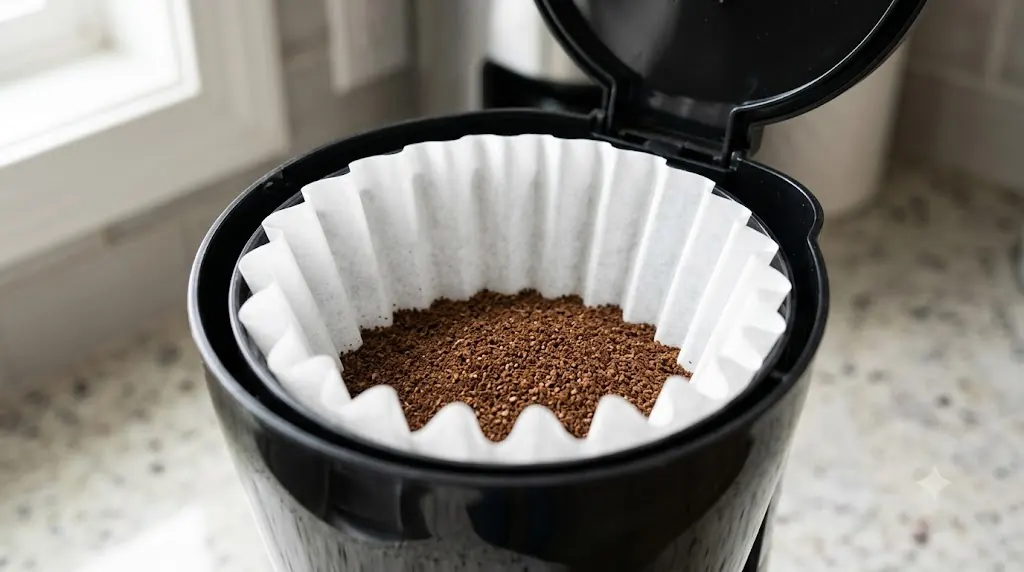
An 8-12 cup basket filter is a round paper liner with a flat base and pleated walls. It belongs in a brew basket with the same basic shape. When seated correctly, the bottom lies level, the side wall opens around the basket, and the paper does not need to be folded into a point. That is the format Amazon lists for ASIN B0C4Z6SKCS and the format Melitta describes for its 8-12 cup basket paper.
The confusing part is the phrase "12 cup." It describes the brewer's nominal batch capacity, not a universal filter shape. Cuisinart's DCC-1200 manual, for example, calls its machine a 12-cup coffeemaker but tells the owner to insert a #4 paper filter. That machine has a cone-style basket. Buying any package that says 8-12 cup without checking the words "basket" or "cone" can leave you with paper that buckles, floats, or cannot cover the basket correctly.
Coffee-maker cup markings also run smaller than a standard 8-fluid-ounce kitchen cup. The same Cuisinart manual defines its cup as 5 ounces. That helps explain why capacity labels are poor measuring tools for filter geometry. The reliable order is machine manual, basket shape, filter format, then pack count. Brand comes later.
| What the basket looks like | Filter direction | What to verify |
|---|---|---|
| Round with a level bottom | 8-12 cup basket-style paper | The paper base lies flat and the wall reaches above the normal grounds bed. |
| V-shaped or wedge-shaped | Usually a #4 cone for many 8-12 cup machines | Use the exact size named in the machine manual; do not force a basket filter into the cone. |
| Small round basket in a 4-5 cup brewer | Often a 1-4 cup basket filter | Compact brewers vary, so the manual and a dry fit matter more than the carafe label. |
| Permanent mesh or gold-tone insert | Use the permanent filter alone unless the manual allows paper | KitchenAid says to use one paper filter or the gold-tone filter, not both together. |
Failure modes
A filter can match the label and still behave badly
Fit is more than getting the paper into the basket. The base needs to sit flat, the pleats need to open instead of folding inward, and the wall needs enough height to stay above the wet coffee bed. A filter that is too small may pull away from the sides. One that is too large can bunch under the lid or water outlet. Either condition gives grounds a path around the paper.
Overflow has several causes, and the filter is only one of them. KitchenAid's product help tells owners to seat the removable brew basket fully, use one filter, keep the drip-stop opening clear, and avoid grounds that are so fine they clog the filter. Cuisinart gives a similar warning: very fine grounds, two or more paper filters, paper used together with a permanent filter, or spilled grounds can cause water and coffee to back up in the basket.
That means buying a "stronger" filter does not solve every messy brew. A full 12-cup batch puts more water and coffee through the basket than a half pot. If the grind is too fine, the dose rises above the safe headroom, the carafe is not operating the drip stop, or mineral and coffee residue restrict the outlet, water can arrive faster than it drains. The useful response is to check the whole flow path rather than blame the paper immediately.
The wall folds inward
Open the paper fully before adding coffee. If it still falls away from the basket, compare the paper diameter and wall height with the machine manual or a known correct filter. Do not tape the filter into a hot appliance.
Grounds appear in the pot
Look for a torn seam, an inward fold, grounds spilled outside the paper, or coffee piled too close to the rim. A few fine particles are different from a visible bypass around the filter wall.
The basket fills with water
Use one filter, check the drip stop, seat the carafe and removable basket, and clean the outlet. If the problem follows a finer grind or larger dose, return to the machine's recommended range.
The brew becomes unusually slow
Paper, grind, dose, and machine cleanliness all affect flow. Change one variable at a time. A slow full pot is not proof that every filter in the pack is defective.
Same-intent product set
Five basket-filter options after the shape check
All five products below target the same basic job: disposable paper filters for 8-12 cup flat-bottom basket-style drip machines. The differences are mainly paper color, seller claims about wall strength, brand, and pack count. None belongs in a #4 cone basket simply because the coffee maker says 12 cups.
Links in this comparison may earn this site a commission. Product details and current prices are shown on Amazon.

Primary fit · ASIN B0C4Z6SKCS
Amazon Basics 8-12 cup basket coffee filters, white, 200 count
Fits when: A straightforward everyday pack for a flat-bottom basket-style home drip maker when 200 white paper filters is a practical quantity.
Skip when: Skip if the brewer uses a V-shaped #4 cone, a small 1-4 cup basket, or a proprietary filter named in the manual.
Check current price on Amazon
Alternative 1 · ASIN B07MLYHRQ9
8-12 cup basket coffee filters, natural unbleached, 500 count
Fits when: A bulk natural-paper option for a household, office, or shared kitchen that uses basket filters often and can store a large count cleanly.
Skip when: Skip when a smaller pack will be easier to keep dry, clean, and rotated, or when the basket is too shallow for the paper wall.
Check current price on Amazon
Alternative 2 · ASIN B00FQRYE40
Melitta 8-12 cup basket filter paper, natural brown, 400 count
Fits when: A natural-brown alternative from a filter manufacturer whose official listing emphasizes thicker paper, shape retention, and basket-style fit.
Skip when: Skip if you prefer white paper, need a smaller count, or have not confirmed that the machine has a flat-bottom basket.
Check current price on Amazon
Alternative 3 · ASIN B07MSGDPR2
8-12 cup basket coffee filters, white, 200 count
Fits when: A same-size white-paper alternative for buyers comparing wall stiffness and pack size without moving to a cone or reusable mesh format.
Skip when: Skip if the listing details, seller, or filter dimensions do not match the brew basket at checkout.
Check current price on Amazon
Alternative 4 · ASIN B00SSBDR2Q
Brew Rite 8-12 cup disposable basket filters, 700 count
Fits when: A high-count disposable option for frequent brewing or a shared supply cabinet where the pack will be used steadily.
Skip when: Skip for occasional home brewing if the large carton will sit open near moisture, dust, or kitchen odors for a long time.
Check current price on AmazonPaper choice
Paper construction matters more than package color
White and natural-brown basket filters can both fit the same brewer. Color alone does not tell you whether the paper will hold its wall, tear at a seam, drain at a sensible rate, or match the basket depth. Melitta sells both white and natural 8-12 cup basket filters and describes its thicker paper as the reason the filters hold their shape. That is a construction claim, not evidence that one color always tastes better.
Full-pot behavior
Headroom matters more when the machine is brewing a full batch
A basket that behaves normally at four cups may struggle at the maximum batch if the coffee bed is very deep or the grind is unusually fine. More water passes through the same outlet, wet grounds expand, and gas released from fresher coffee can lift the bed. The paper wall needs to remain open and above that moving surface. This is why "fits most 8-12 cup basket coffeemakers" should be read as a format description, not permission to fill the basket to the rim.
Use the coffee maker's own dosing guidance as the starting point. Manuals vary, and dark roasts, fine grinds, and dense doses do not all drain at the same speed. If a full pot backs up, reduce only one variable at a time: return to the recommended grind, confirm the dose, clean the drip stop and basket outlet, and make sure the carafe is seated. Replacing the filter brand while leaving a clogged outlet untouched will hide the real cause.
The paper should also stay clear of moving parts. A pleat trapped under the basket handle, lid, spray head, or drip-stop mechanism can create an uneven rim. Before brewing, look once around the circumference. The filter should be open, centered, and free of sharp folds. That simple visual check prevents more problems than trying to reshape wet paper after hot water has started flowing.
Practical check
A five-minute dry fit before the first full pot
Do this with a cool, unplugged machine. The goal is not to test performance; it is to catch an obvious shape or seating mismatch before hot water and coffee make the problem harder to see.
- Remove the brew basket. Ignore the carafe label for a moment and inspect the basket itself.
- Confirm the bottom shape. A basket filter needs a round, level base. A V-shaped holder points to a cone filter.
- Open one filter completely. The paper base should rest flat without being forced into a point.
- Check the wall and lid clearance. The rim should stay open without bunching under the lid, spray area, handle, or valve.
- Read the manual before stacking anything. Use one paper filter or the permanent filter unless the manufacturer says otherwise.
- Start with a normal, monitored batch. If drainage is slow or grounds bypass the rim, stop and inspect fit, grind, dose, basket seating, and the drip stop.
Cleanup and disposal
Paper simplifies grounds cleanup, but it cannot repair a dirty flow path
A disposable basket filter makes cleanup direct: lift the cooled paper and grounds together, then rinse the removable basket. It does not clean the drip stop, spray head, outlet, carafe lid, or mineral scale elsewhere in the machine. When overflow appears after months of normal brewing, inspect those parts before assuming the current pack of filters suddenly changed.
For households that compost, the U.S. Environmental Protection Agency lists coffee grounds and paper filters among materials that can go into a backyard compost pile. Municipal collection rules still vary, and packaging claims are not a substitute for local guidance. Remove any plastic, staples, labels, or non-paper material before composting, and treat the retail bag separately.
Paper filters and permanent mesh filters also produce different cleanup and cup characteristics. A reusable filter avoids a disposable sheet but needs washing after every use and may pass more fine sediment. That is a legitimate alternative, but it is a different ownership decision. The five products on this page stay within disposable basket paper so the comparison does not drift into a second guide.
How this guide was checked
Product fit and pack details were checked against the Amazon pages for the five ASINs on July 10, 2026. Shape and paper guidance was cross-checked with Melitta's official basket-filter pages. Overflow and filter-stacking cautions came from KitchenAid product help and Cuisinart's DCC-1200 manual. Compost guidance came from the U.S. EPA. No hands-on brewing, flow-rate measurement, or taste test was performed, so the page does not rank brands by taste or claim a universal best filter.
Related kitchen routines
Useful next steps
Common questions
Basket filter questions that come up before checkout
Can I use a #4 cone filter in a flat-bottom basket?
Not as a normal substitute. A #4 cone is shaped for a V-shaped holder. In a round basket it can fold, leave uncovered areas, or sit too high. Use the format named in the machine manual.
Why does a basket coffee filter collapse during brewing?
Common causes include the wrong size, paper that was not opened fully, a wall that is too short for the basket, grounds piled near the rim, or water backing up because the outlet is restricted. Check fit, dose, grind, basket seating, and the drip stop together.
Can I put a paper filter inside a permanent mesh filter?
Use one filtration path unless the coffee maker manual explicitly approves a combination. KitchenAid says to use one paper filter or the gold-tone filter, and Cuisinart warns that combining paper with a permanent filter can contribute to backing up.
Are white basket filters better than natural brown filters?
Color alone does not settle fit, strength, flow, or taste. Start with basket shape and size, then compare the manufacturer's paper and processing information. Both white and natural-brown products can be made for the same 8-12 cup basket format.
Can used paper coffee filters go into home compost?
The U.S. EPA lists coffee grounds and paper filters as materials for a backyard compost pile. Check local collection rules, and keep plastic packaging, labels, or other non-paper parts out of the compost.