Jump to a section
01 / Geometry
Fit starts at the base, but it does not end there
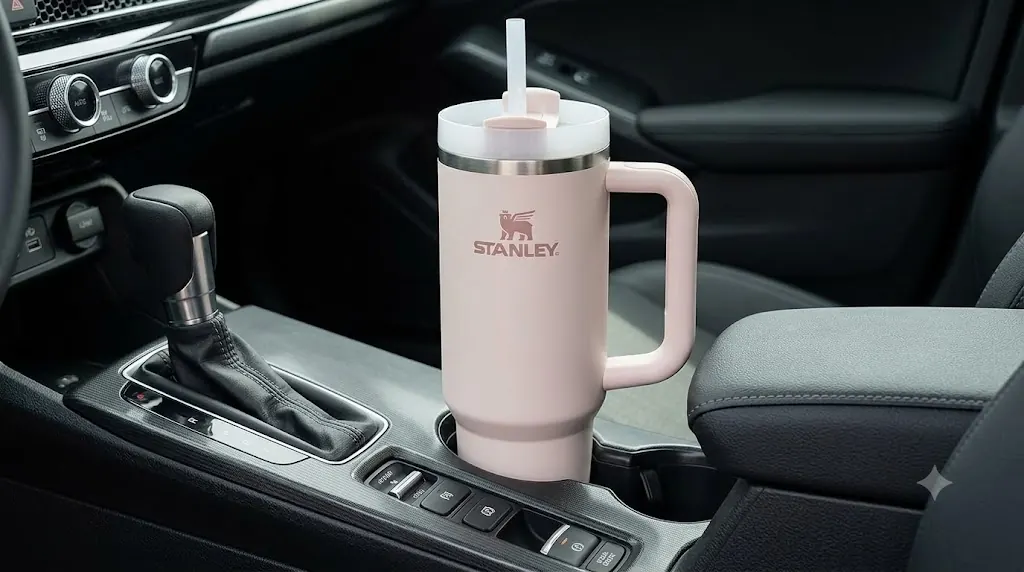
The number most product pages give you is the base diameter. It matters because the lower portion must pass through the cup-holder opening, and Stanley lists the 30 oz Quencher base at 3.15 inches. That figure is useful, but it does not describe the whole console. Many holders narrow below the opening, use flexible tabs, or sit beside a raised divider. A tapered cup can enter at the rim and stop lower down. The opposite can happen too: the base sits correctly, while the wider body or the handle presses against the console before the cup reaches a stable depth.
Depth changes the amount of support. A deep holder surrounds more of the lower body, so the rim of the holder resists side movement. A shallow holder leaves more of the tumbler above the support point. The cup then acts like a taller lever, especially after it is filled. This does not mean a shallow holder always fails. It means that an empty-cup test is weak evidence. The same cup that feels calm on the driveway can rock more once roughly two pounds of water have been added.
Imagine a compact center console with a 3.30-inch opening that narrows to 3.20 inches. A 3.15-inch base may clear it, but the margin is small enough that rubber tabs or a slight tilt can matter. If the holder is also shallow and the shifter sits close to the passenger side, the handle may need to face forward or toward the driver. Now compare that with a deep SUV console that has a broad open area around the holder. The same base can sit lower and the handle can rotate freely, even though both vehicles advertise a standard cup holder.
Upper clearance is the last part of the shape. Check for a dashboard shelf, sliding armrest, second cup, charging cable, or control knob beside the holder. The practical definition of cup-holder fit is simple: the cup seats deeply enough to remain stable, the handle has a usable resting position, the upper body and straw do not collide with nearby hardware, and the driver can leave it alone without readjusting the setup while moving.
02 / Field check
A parked-car fit check that takes less than a minute
Do the check before the first commute and make every adjustment while the car is parked. Start with the empty, clean cup so you can rotate it without spilling. Then repeat the stability part with plain water. The second pass matters because the filled cup has a higher total mass, and that mass amplifies any looseness at the rim or interference around the handle.
- Seat the base without forcing it.The cup should reach a natural stop. If flexible holder tabs bend hard or the cup wedges at an angle, count that as a marginal fit rather than a pass.
- Rotate the handle through the usable positions.Look for contact with the shifter, parking brake, armrest, nearby controls, charging cables, and a second cup.
- Check upper-body and straw clearance.Slide the armrest and move any console cover that normally changes position. The straw should not press against a shelf or dashboard edge.
- Fill with water and press lightly from four directions.A small amount of movement is normal. A cup that climbs out of the holder, tips easily, or transfers force into a control needs a different position or a smaller vessel.
- Choose the lid state before leaving.Set the straw, drink opening, or closed position while parked. Do not build a routine that depends on rotating the lid or moving the handle during traffic.
A pass is not a promise that the cup will remain motionless during every turn or stop. It means the cup is upright, supported, clear of controls, and suited to the route you actually use. If the holder is shallow, the console crowded, or the fit tight enough to need two hands for removal, a 20 to 24 oz vessel may be the more practical answer even when the 30 oz base technically enters the holder.
03 / Carry mode
The travel path decides how much closure you need
An open straw or rotating lid can work because the cup stays upright and the user controls it.
Splash control and handle clearance matter more. The cup still needs to remain upright.
Use a closure whose maker supports that exact closed state, or switch to a sealed bottle.
This ladder prevents a common buying mistake: treating every leakage claim as though it describes the same test. An open reusable straw creates a liquid path. A rotating cover can reduce exposure at the top, but its closed position does not automatically turn the cup into a bottle. Some products make stronger claims only after the straw is removed. Others use a flip straw or a locking valve. Read the condition attached to the claim, not just the word printed near it.
04 / Capacity
What changes when you move from 30 to 40 ounces
Capacity affects more than refill frequency. Ten additional fluid ounces of water weigh about 10.4 ounces, or roughly 0.65 pound. A full 30 oz cup holds close to 1.96 pounds of water before the weight of the tumbler is added. A full 40 oz cup holds about 2.61 pounds of water before its larger vessel is counted. Exact finished weight varies by model, but the difference in water alone is enough to notice during a walk from the parking lot to an office.
| Daily situation | 30 oz tends to make sense | 40 oz may make sense |
|---|---|---|
| Compact console | Lower height and less water mass usually make the fit easier to manage. | Only after checking handle, upper-body, and control clearance. |
| Refills are nearby | Good match when a sink or dispenser is available during the day. | The extra capacity may add weight without solving a real problem. |
| Long shift or road trip | Works if a refill stop is acceptable and easier carrying matters. | Useful when refill access is limited and the larger cup fits securely. |
| Limited grip or one free hand | Less water to lift and carry, though the full cup still deserves a real test. | Can become tiring even when the handle itself feels comfortable. |
The right size depends on the whole route. Someone who fills the cup at home, drives twenty minutes, and has a water station at work may gain little from the larger size. Someone working outside or spending hours between refill points may accept the extra height and weight. Neither choice should be made from capacity alone. Console fit, filled lift, refill access, and the need for a closed carry state all belong in the same decision.
For a separate look at smaller closed drinkware, see the guide to insulated straw-lid bottles for school and work. A bottle is often the cleaner substitute when the vessel needs to travel inside a bag rather than remain upright in a console.
05 / Lid behavior
Match the lid to how the cup will travel
A tumbler lid has two separate jobs: it provides a drinking path and it limits liquid movement when the cup is jostled. Those jobs compete. A wide drink opening is easy to use but leaves a direct path for liquid. A reusable straw is convenient at a desk or in an upright cup holder, yet the straw channel remains open unless another part closes it. A flip straw or locking valve adds a closure step, which can improve transport behavior when the maker supports that state.
| Lid description | What it usually means in practice | Where it belongs |
|---|---|---|
| Open straw | The easiest sipping path and the weakest choice for tipping or horizontal carry. | Upright console and desk use. |
| Rotating cover | Several drinking positions and a covered top, but the exact spill boundary depends on the opening and seal. | Upright use with some splash control. |
| Leak-resistant straw lid | Designed to reduce leakage, not necessarily to stay dry when laid flat for a long time. | Upright commuting with occasional bumps. |
| Flip straw | The straw folds into a closed position. The strength of the seal still depends on the specific design and maker claim. | Users who want a clearer open-versus-closed routine. |
| Locking closure | A valve or lock closes the drinking path, sometimes only after the straw is removed. | Transport that needs a deliberate closed state. |
Stanley describes the standard Quencher H2.0 straw opening as splash resistant. That is a useful boundary. It supports upright drinking in a cup holder, but it should not be read as a promise that the vessel can lie in a backpack. The standard model also offers a drink opening and a full-cover position through the rotating FlowState lid. Those positions change how the top is exposed, yet they do not erase the need to keep the vessel upright unless the maker explicitly supports another orientation.
The alternatives on this page illustrate why the condition matters. The Meoky and Contigo examples attach stronger closure behavior to removing the straw. The Stanley ProTour uses a flip-straw path. Simple Modern describes a leak-resistant lid. These are not interchangeable claims, and this guide does not rank their performance because it does not include an independent leak test. The useful comparison is the routine each design asks you to follow.
Choose the routine first. If the cup goes from kitchen counter to car holder to desk, an open straw may be the simplest arrangement. If the cup moves between a car, gym locker, and tote bag, a flip or lock becomes more important. If the vessel must ride horizontally for any meaningful time, a closed bottle is a better product type than an open-straw tumbler. No amount of careful wording makes an open liquid path behave like a sealed container.
06 / Care
Cleaning is part of the buying decision
A handled tumbler can be easy to rinse while still having several places that hold residue. The straw bore, the underside of the lid, removable seals, sliders, and the thread around a screw-on lid need attention. Stanley lists the Quencher as dishwasher safe, and its care guidance also recommends separating parts, using gentle soap and non-abrasive tools, avoiding bleach or chlorine, and allowing components to dry open. Dishwasher-safe does not mean the lid should remain assembled with moisture trapped between parts.
- Take the lid and straw apart as far as the maker allows. Do not pry out seals that are not meant to be removed.
- Wash the straw bore and the underside of the lid. A narrow brush is more useful than forcing a sponge through a small channel.
- Rinse away soap from threads and seals. Residue left in those areas can affect taste and make the lid feel sticky.
- Dry every part separately. Leave the lid off the cup until the straw, seal area, and lid cavity are dry.
Plain water usually leaves less residue than sweetened, dairy-based, protein, or flavored drinks. Those drinks deserve prompt disassembly rather than an overnight soak in the car. Heat inside a parked vehicle can make old residue harder to ignore and may affect the smell of plastic or silicone parts. The safe response is not a harsh chemical shortcut. Follow the product care instructions, use gentle tools, and replace a damaged straw or seal instead of scrubbing it with an abrasive that changes the surface.
Cleaning burden should influence the lid choice. A simple removable straw can be easy to inspect. A flip or locking mechanism offers a stronger closure path but may add hinges, valves, or recesses that need their own cleaning method. For a deeper maintenance routine, see the guide to cleaning straw lids after workouts.
07 / Product examples
Five 30 oz options, sorted by the job they solve
Use these products to compare closure routines, not as a best-to-worst ranking. All five are 30 oz handled tumblers intended for the same broad cup-holder and straw-drinking job. The differences become useful after you know whether the cup will stay upright, whether the straw can be removed, and whether you need a flip or locking state. Product titles, images, and links should be rechecked before publication because marketplace details can change.
This page may earn a commission from eligible purchases made through the Amazon links below. The price you pay is unchanged.

Primary example / Upright straw use
Stanley Quencher H2.0 FlowState Tumbler, 30 oz
Good fit when: Choose it for upright car-to-desk use when the 3.15-inch tapered base, side handle, open straw, and rotating sip positions suit the console and daily routine.
Skip when: Look elsewhere when the cup must lie in a bag or on a passenger seat. The standard straw opening is made to resist splashes, not to behave like a sealed bottle.
ASIN B0CP9YB3Q4
Check current price on Amazon
Alternative 1 / Straw-removal seal
Meoky 30 oz Tumbler with Handle and Straw
Good fit when: Consider it when a wide handle, non-slip base, and a closure that can be sealed after the straw is removed match the way the cup will travel.
Skip when: Do not assume the straw-in setup carries the same leakage claim as the straw-removed state. Check the exact lid configuration before transport.
ASIN B0CWNG6BJJ
Check current price on Amazon
Alternative 2 / Leak-resistant lid
Simple Modern Trek Tumbler with Handle and Straw Lid, 30 oz
Good fit when: A reasonable alternative for the same handled, cup-holder-oriented format when a leak-resistant straw lid and two supplied straws matter.
Skip when: Skip it if horizontal bag transport requires a verified locking closure rather than a leak-resistant straw lid.
ASIN B0CHCF2QCQ
Check current price on Amazon
Alternative 3 / Flip-straw closure
Stanley Quencher ProTour Flip Straw Tumbler, 30 oz
Good fit when: This is the closer Stanley-family match when a built-in flip straw and a more deliberate closed-lid carry path matter more than the standard rotating lid.
Skip when: The extra closure step may be unnecessary if the cup will always stay upright and you prefer a removable straw with several drinking positions.
ASIN B0DCDZP98B
Check current price on Amazon
Alternative 4 / Locking state
Contigo SnapSeal 30 oz Tumbler with Handle and Reusable Straw
Good fit when: Consider it when you want a handled 30 oz cup with a SnapSeal closure and are comfortable removing the straw before using the locked transport state.
Skip when: It is a poor match if you want one unchanged straw-in setup to cover both sipping and sealed horizontal carry.
ASIN B0GH8K82JK
Check current price on Amazon08 / Primary example
Where the standard 30 oz Quencher fits well
The Stanley Quencher H2.0 30 oz makes the most sense when the route is upright and predictable. Its published 3.15-inch tapered base gives the shopper a real measurement to compare with the vehicle. The handle helps with the walk from the parking lot to a desk, and the FlowState lid provides a straw opening, a drink opening, and a covered position. For a commuter with a clear center console and regular refill access, that combination can be more manageable than moving to a 40 oz cup simply for extra capacity.
The same design has clear limits. The handle can collide with a shifter or armrest even when the base fits. A full cup is much heavier than the empty vessel shown on a shelf. The standard straw path is intended for upright use and splash control, not for a tumbler that will roll across a passenger seat. People who need a cup to disappear into a backpack should start with a closed bottle or a lid whose maker supports a locked transport state.
This guide has not physically tested the Rose Quartz 2.0 cup in a particular vehicle, measured insulation, or run a leak, drop, or durability test. The recommendation comes from the published dimensions, lid design, care guidance, product-set comparison, and a user-applied fit method. Treat the 3.15-inch base as a starting measurement, then let the parked-car check decide whether the console and routine agree with it.
Choose the standard 30 oz Quencher for upright console-to-desk use. Choose a flip, lock, or closed bottle when the vessel must tolerate tipping or horizontal transport.
09 / Avoidable errors
Common fit mistakes to avoid
Treating "cup-holder compatible" as universal
A published base size cannot describe the holder depth, tabs, divider, handle path, or dashboard clearance in your vehicle. Use the number to screen candidates, then test the complete shape while parked.
Testing only the empty cup
An empty tumbler can feel stable because there is little mass above the holder rim. Add water and the same looseness becomes more obvious. Repeat the stability check with plain water before relying on the setup.
Forgetting the handle's resting position
A handle that touches the shifter or presses a neighboring cup is more than an annoyance. It can force the tumbler to sit at an angle or tempt the driver to keep readjusting it. Find one clear resting position before the car moves.
Confusing upright sipping with bag transport
A splash-resistant opening is useful around bumps and normal movement. It is not the same as a closed, verified transport state. If the cup may lie down, change the lid type or change the vessel type.
Assuming dishwasher-safe means maintenance-free
Dishwashers do not guarantee that every channel separates, drains, and dries. Remove the parts the maker allows, inspect the straw and seal area, and let them dry before reassembly.
Most disappointing tumbler purchases are not caused by a missing headline feature. They come from a mismatch between the console, the filled weight, the closure routine, and the way the cup is actually carried. A short measurement and fit check removes more uncertainty than comparing another dozen color options.
Research note
How this guide was researched
Last reviewed July 10, 2026. Product identity and images were checked on the five Amazon product pages. Durable dimensions, lid language, materials, and care guidance came from Stanley's official product and cleaning pages. Marketplace reviews and community discussions were used only to identify recurring concerns such as filled weight, cup-holder uncertainty, refill frequency, and upright leakage. No review text, rating, or review count is reproduced here, and no hands-on vehicle test is claimed.
FAQ
Questions that come up before buying
Will every 30 oz tumbler fit a standard car cup holder?
No. Capacity does not define the base shape, handle position, upper-body width, or holder depth. Compare the published base measurement with the narrowest usable part of the holder, then check the complete cup in the parked vehicle.
How should I measure a cup holder?
Measure the opening, the narrowest point below it, and the usable depth. Then note the free space around the rim for the handle and upper body. Flexible tabs and nearby controls can reduce the practical clearance.
Is 30 oz easier to commute with than 40 oz?
Often, but not always. Ten extra fluid ounces add about 0.65 pound of water before the larger cup's own weight is counted. The 30 oz size is usually easier to lift and fit, while 40 oz can reduce refills when the console and user can handle it.
Can a straw tumbler go in a backpack?
Only when the maker supports the exact closed configuration you plan to use. An open straw or splash-resistant opening is not a bag-safe seal. For horizontal transport, a locked lid or a closed bottle is the safer product type.
Does leak resistant mean leakproof?
No. Leak resistant describes reduced leakage under stated conditions. Leakproof should be tied to a specific lid position, valve, lock, or straw-removal condition from the maker. This guide does not independently test those claims.
How often should the straw and lid be cleaned?
Wash before first use and after drinks that leave residue. Plain water may allow a simpler daily rinse, but sweetened, dairy-based, protein, or flavored drinks deserve prompt disassembly, washing, rinsing, and full drying.
Can I use a handled straw tumbler for hot drinks?
Follow the exact product and lid instructions. Do not assume a straw opening that works for cold drinks is appropriate for hot liquid. Use the lid and temperature range approved by the maker, and avoid any setup that could expose the face to hot liquid through a straw.
The short version
Measure the console, then choose the carry routine
A 30 oz tumbler earns its place in the car when the base seats naturally, the holder supports enough of the body, the handle clears nearby controls, and the lid matches the way the cup will travel. If any one of those checks fails, changing size or closure style is more useful than forcing the wrong cup into the routine.