01 / Carton condition
Start with the box, not another strip of tape
A suitable tape cannot turn a damaged carton into a sound one. Before comparing adhesives, look at the box with the contents already inside. The top flaps should meet without being held down by force. Corners should still carry their shape. The liner should feel dry rather than soft, swollen, or cool from moisture. Tears, punctures, crushed sidewalls, deep abrasion, and old adhesive residue all reduce the amount of dependable surface available for a new seal.
Overfilling creates a different problem. When the contents push the flaps into a permanent bow, the box is continuously trying to open. That load works against the tape at the edge of the strip, where peeling can begin. A stronger-sounding label does not remove the force. Repack the contents, use a larger carton, or choose a box with enough strength for the load. Adding strips over a bowed seam often hides the real failure for a while without fixing it.
The carton is dry, square, untorn, and closes flat with normal hand pressure.
The box is sound, but the contents are pushing the flaps upward or leaving no room for cushioning.
The liner is damp, crushed, punctured, deeply worn, or weakened at the corners and seams.
Reused boxes deserve the same check. FedEx's current US packing page says an old box can be reused when it remains sturdy and has not been crushed, torn, punctured, or otherwise damaged. That is a useful boundary even when the box is not going through FedEx. Reuse is reasonable when the structure still works. Reuse becomes false economy when the carton has already spent its strength on an earlier trip.
Watch where the seal first moves. A flap that springs up before the tape is applied points to fit or box-size stress. A box that closes flat but releases along the full strip points more toward surface contact or tape choice. A strip that holds in the middle and lifts only at one damaged edge points back to local abrasion, dust, old tape, or a crushed corner. The location of the failure is more useful than the number of extra layers already on the box.
02 / Why the surface matters
Why recycled corrugated can be harder to seal
Recycled cardboard is not simply a weaker version of new cardboard. The surface can behave differently. Tape University, published by Shurtape Technologies, explains that recycled fibers have been chopped and repulped. The shorter fibers are packed with fillers to form the liner sheet, which can produce a tighter, less porous surface than a liner made from longer virgin kraft fibers. A pressure-sensitive adhesive then has fewer easy paths into the surface structure.
This matters because pressure-sensitive tape does not form its bond merely by touching the box. The adhesive needs close contact across the strip. Pressing the tape down helps it conform to small surface variations and reach the available fiber structure. On a less porous recycled liner, that application pressure becomes especially important. Laying a strip lightly across the seam and cutting it off may leave the tape attached well enough to look finished while the edges are still waiting to lift.
The explanation also corrects a common shortcut. Search summaries sometimes describe recycled boxes as loose or dusty by definition. A particular reused box can certainly be dusty, worn, or abraded, but the category mechanism described by Tape University is a tightly packed, less porous liner surface. Those are different problems. Dust calls for a clean, usable box surface. Lower porosity calls for a tape and application method that can create dependable contact.
Not every recycled carton has the same fiber mix, coating, print coverage, age, or handling history. You cannot identify the adhesive requirement from the recycling symbol alone. Treat the surface explanation as a reason to inspect and apply carefully, not as proof that one product will hold on every carton. A heavily printed or coated box, a rough reused flap, and a new plain kraft carton may all respond differently even when each contains recycled fiber.
03 / Failure diagnosis
Trace the failure before changing products
Tape failure is usually easier to solve when you stop treating every loose seam as the same problem. Look at the first place the strip releases, then compare that symptom with the carton, the application, and the tape system. The table below is a starting point, not a laboratory diagnosis. Several causes can exist at once, especially on an old box.
| What you see | Likely area to inspect | Try next | Do not assume |
|---|---|---|---|
| Edges lift soon after application | Low pressure, short overlap, rough edge, dust, abrasion, or constant flap stress | Check box condition, flatten the flaps, apply a fresh strip, and press the full length | That a thicker backing alone will fix the bond |
| The whole strip releases cleanly | Tape-to-liner mismatch, coated surface, poor contact, moisture, or contamination | Move to a sound dry carton or a tape system intended for the surface | That random extra layers create better contact underneath |
| The center holds but the box opens at the side seams | Incomplete seam coverage | Use a deliberate seam pattern such as an H-seal when the route calls for it | That one strip over the center closes every path into the box |
| The tape remains attached but the cardboard tears | Carton structure or overloaded contents | Replace or repack the box | That stronger adhesive can restore torn corrugated board |
| The strip splits, slivers, or loses its end during use | Backing, cutting method, dispenser control, or hurried application | Match the roll and core to a suitable dispenser and slow the cut-and-press sequence | That adhesion is the only property that matters |
Suppose a reused delivery box closes flat, but a clear strip begins lifting at one end within minutes. Run a controlled retry instead of wrapping the box repeatedly. Remove the failed strip without tearing away more liner, inspect the endpoint, and make sure the flap is dry and intact. Apply one fresh strip to a usable surface and press along it from end to end. If the new strip holds except where the carton is scuffed, the surface damage is controlling the result. If it releases evenly, tape choice or liner compatibility moves higher on the list.
Now consider a book box whose flaps rise as soon as your hand moves away. That is not the same test. The contents are pushing against the closure, so the adhesive is under continuous peel stress. Repacking the books or using a larger, stronger carton changes the force before the tape is asked to hold it. This is one reason product reviews can disagree without either experience being fabricated: the boxes, surfaces, fill levels, application pressure, storage conditions, and seam patterns may have been different.
Temperature can affect packing work, but this page does not claim a tested cold- or hot-weather range for the five products. If the box and tape have been stored in a very cold garage or a hot vehicle, bring them into the intended packing environment and follow the maker's directions before drawing a conclusion. Without a controlled comparison, it is better to state that environment may matter than to invent a temperature threshold.
04 / Seam coverage
Build an H-seal across the top and bottom
An H-seal covers more than the center joint. One strip closes the long center seam where the major flaps meet. Two more strips close the edge seams at the ends of those flaps, creating an H shape when viewed from above. The same pattern is applied to the bottom. This matters because a box can remain closed at the center while an edge seam opens under handling.
- Inspect the bottom before loading.If the original bottom seal is loose, damaged, or unknown, address it while the box is still easy to turn over.
- Close the flaps without forcing them.The edges should meet cleanly. Repack an overfilled box instead of using tape to pull a bow flat.
- Center the first strip over the main seam.Keep the strip straight enough to contact both flaps along its full length.
- Cover the two edge seams.These strips complete the H pattern and close the flap endpoints that a center-only seal leaves exposed.
- Press every strip into the liner.Run firm, even pressure along the tape rather than pressing only at the ends.
- Repeat on the other face.For a shipping box, top and bottom both need deliberate seam coverage.
Center seam plus both edge seams, repeated on the bottom.
Carrier guidance adds a width boundary. FedEx's current US packing page says to use pressure-sensitive plastic tape, water-activated paper tape, or water-activated reinforced tape that is at least 3 inches wide, applied evenly across the top and bottom flaps and seams with the H-taping method. The Scotch product anchored on this page is 1.88 inches wide. It therefore should not be presented as meeting that current general FedEx width guidance.
You may also find an older FedEx PDF that says at least 2 inches. The current US packing page says 3 inches, so this guide uses the current page for a shipment prepared today. Carrier instructions can change, and different carriers or services may publish different requirements. Check the route you are actually using. A tape can be useful for moving, storage, or general box closure without satisfying a particular carrier's current width recommendation.
3M's statement that the Scotch Heavy Duty family can seal a seam with one strip does not cancel the H pattern. One strip per seam and one strip for the whole box are not the same thing. The H method identifies several seams on each face. The manufacturer's claim concerns how many layers may be needed on an individual seam under its stated conditions; the carrier method concerns which seams should be covered.
05 / Tape specifications
What width, backing, adhesive, and roll format actually tell you
Packaging-tape specifications answer different questions. Width describes how much surface a centered strip can cover. Thickness describes the combined tape construction, but it is not a universal adhesion score. The backing affects tearing, splitting, and handling. The adhesive has to bond to the actual liner. Roll length and core size affect how often the roll is changed and which dispenser can hold it. Reading one number as the whole answer is how shoppers end up comparing products that solve different parts of the job.
| Specification | What it helps you judge | What it does not prove |
|---|---|---|
| Width | Surface coverage and fit with current carrier or workplace instructions | Adhesion to a particular recycled liner |
| Total thickness | Part of the backing-and-adhesive construction and handling feel | That the thickest option will stick best |
| Adhesive type | The general bonding system and intended use conditions | A measured winner on every carton or climate |
| Backing material | How the strip handles tension, cutting, splitting, and transparency | That the carton itself can carry the load |
| Roll length | How many changes a packing routine may require | Value without a current compliant price source |
| Core and dispenser | Compatibility, cutting control, tape-end retention, storage, and hand fatigue | Bond strength after poor application |
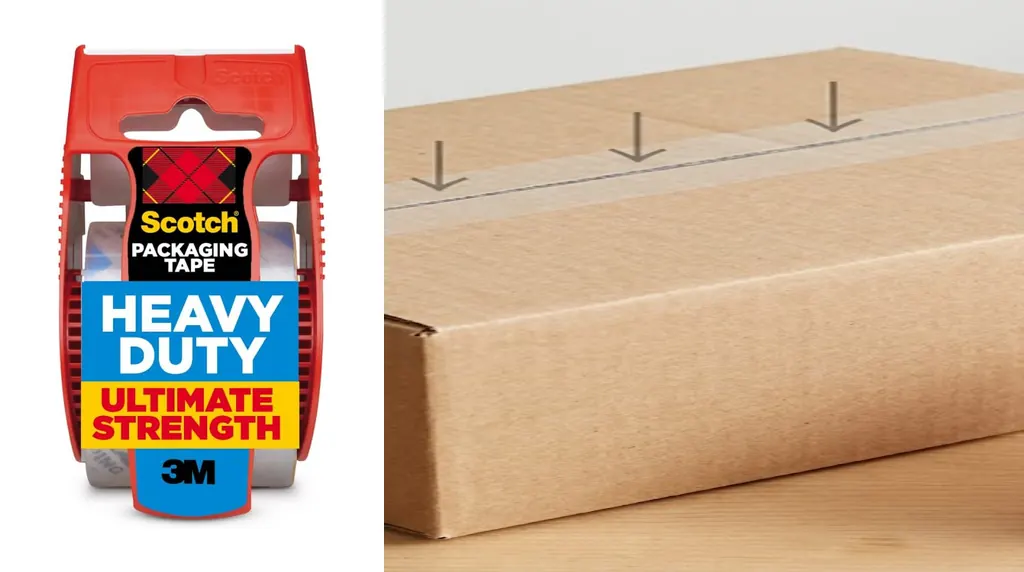
3M lists the Scotch Heavy Duty family as a hot-melt adhesive on polypropylene film, with a 1.5-inch core for the compact dispenser, a 1.88-inch width, and roughly 3.0-mil construction depending on the variant. The observed B000MVV6AA configuration is one 27.7-yard roll with the small dispenser. Those facts explain the product's role: an occasional-use clear-tape kit that stores more easily than a full-size gun and does not require the buyer to source a dispenser separately.
The same specifications reveal its limits. A 1.5-inch-core compact dispenser is not the natural setup for a packing station that seals dozens of cartons each day. A 27.7-yard roll will need replacement sooner than a long refill. The 1.88-inch width does not match FedEx's current 3-inch general guidance. None of those points means the tape is poor. They mean the product is designed for a different routine than a high-volume carrier-compliance station.
Noise is another fit issue that rarely appears in a specification table. Hot-melt packaging tapes can feel or sound different during unwind, and user discussions frequently mention loud tape as a nuisance in home offices and shared spaces. This page did not measure sound, so it does not rank the five products by noise. If quiet operation matters, buy the smallest practical quantity or test the exact tape/dispenser combination before committing to a bulk pack.
06 / Product roles
Five tape setups for the same hard-to-seal box
These products are grouped by the job they suit, not ranked by an untested strength score. All five address moving, storage, or shipping-box closure, but they differ in adhesive positioning, material, roll quantity, length, and dispenser setup. The cards use current-price-safe links and do not reproduce Amazon prices, ratings, review counts, coupons, or availability.
Links in this comparison may earn this site a commission. Product details and current prices are shown on Amazon.

Primary example / Compact one-roll kit
Scotch Heavy Duty Shipping Packing Tape with Dispenser
Best fit: Occasional moving, storage, returns, or parcel preparation when one 1.88-inch clear hot-melt roll and a compact dispenser are more useful than a bulk case or full-size gun.
Skip when: The job needs a 3-inch tape to follow current FedEx general guidance, a paper-based system, or enough daily volume to justify long refills and a larger dispenser.
What the evidence supports: 3M says this family works on harder-to-stick 100% recycled boxes. That is a manufacturer statement, not an independent adhesion test or carrier-compliance finding.
ASIN B000MVV6AA
Check current price on Amazon
Alternative 1 / Multi-roll clear route
Scotch Box Lock Clear Extreme Grip Packing Tape
Best fit: Repeated hard-to-stick carton work when a six-roll clear-tape supply makes more sense than a single compact roll.
Skip when: Packing is occasional, storage space is limited, or the buyer wants a paper tape that can remain with the box through the chosen recycling process.
What the evidence supports: The product role comes from the listing's clear extreme-grip positioning and pack format. This page does not compare its peel strength with the primary Scotch tape.
ASIN B08KWJR7LW
Check current price on Amazon
Alternative 2 / Pressure-sensitive paper route
Scotch Box Lock Paper Packing Tape
Best fit: A buyer who wants a pressure-sensitive kraft paper path and prefers tape intended to stay with the box in the recycling stream.
Skip when: A transparent seal, a verified water-activated industrial system, or a specific moisture-exposure performance claim is required.
What the evidence supports: This is a paper-material alternative within the same sealing problem. Local recycling rules and actual recovery practices still vary.
ASIN B0CGY5H3S8
Check current price on Amazon
Alternative 3 / Moving-focused clear tape
Scotch Tough Grip Moving Packing Tape
Best fit: A household move where a three-roll clear-tape supply and moving-oriented product positioning suit the number of cartons.
Skip when: The carton is weak, damp, torn, overfilled, or too small. Moving-focused tape does not repair an unsuitable box.
What the evidence supports: The product belongs here as a moving option. No independent heavy-box or drop comparison was performed.
ASIN B06Y1SZGQ8
Check current price on Amazon
Alternative 4 / Long-refill setup
Duck HD Clear Packing Tape Refills
Best fit: Repeated clear-tape work when long refill rolls and an existing compatible dispenser matter more than a compact one-roll kit.
Skip when: A dispenser must be included, recycled-carton-specific grip evidence is required, or the buyer wants a paper tape route.
What the evidence supports: The longer refill format changes roll-change frequency. It does not prove stronger adhesion to a particular recycled liner.
ASIN B000GR5XCW
Check current price on AmazonAll five cards use roughly 1.88-inch product formats in the observed listings. They are useful comparisons for adhesive, material, quantity, and dispenser setup, but this set is not presented as satisfying FedEx's current 3-inch general tape-width guidance.
07 / How the route changes the answer
Moving, shipping, storage, and daily packing are different jobs
Apartment move
Cartons may be carried by hand, stacked in a van, and opened soon after arrival. Box condition, flap stress, and enough tape for the number of cartons matter more than long storage aging. A compact one-roll kit can fit a few boxes; a multi-roll pack is easier for a whole apartment.
Carrier shipment
The carrier's current instructions become part of product fit. For FedEx, the current US page specifies listed tape types at least 3 inches wide and an H pattern on top and bottom. None of the 1.88-inch cards should be treated as an automatic match for that requirement.
Closet or garage storage
The box may sit for months and be stacked. Start with a dry, structurally sound carton and avoid trapping damp contents. This page has no controlled long-term or temperature test, so do not turn a short application success into a storage-life guarantee.
Small ecommerce packing station
Roll length, dispenser comfort, tape-end control, and repeatable pressure become daily operating issues. A compact dispenser that is convenient for one return can be tiring when dozens of boxes are packed. A compatible full-size dispenser and longer refills may be the more practical system.
A renter reusing delivery boxes for an across-town move has a different decision from a seller preparing a one-time high-value FedEx shipment. The renter may reasonably choose a 1.88-inch heavy-duty tape after inspecting the cartons and applying it carefully. The seller needs to check the current carrier requirements, box design, cushioning, declared value, and whether a tested packaging process is warranted. The keyword is the same, but the consequence of failure is not.
Quiet workspaces add another small but real constraint. Packing tape unwind can be abrupt in a home office, shared mailroom, or late-night apartment. Because the five products were not sound-tested, the honest method is to test the exact roll and dispenser in the intended space before buying a large supply. Noise should be a fit check, not a made-up performance ranking.
08 / When to change systems
When clear pressure-sensitive tape is the wrong system
Clear tape is convenient because it is familiar, quick to apply, and easy to inspect. It is still only one sealing system. The right alternative depends on the reason the current setup is failing. Changing materials without naming the failure can be just as wasteful as adding more clear tape.
Fits users who want a hand-applied paper route without adding a water-activation step. Check the product's surface and recycling instructions rather than assuming every paper tape behaves the same way.
Can form a different bond with corrugated board and is common in higher-volume packing operations. It requires the correct tape, water/application setup, and process. It is not automatically the easiest choice for one household return.
Useful when the task is reinforcement rather than ordinary seam closure. It should not become a shortcut for an undersized or structurally failed carton.
The right answer when the old carton is damp, torn, crushed, punctured, or permanently bowed. No tape architecture replaces sound corrugated structure.
Paper tape is not automatically stronger, greener, or more acceptable in every recycling program. Clear plastic tape is not automatically wrong for every recycled carton. Water-activated tape is not automatically cost-effective for occasional use. Each path changes the application method, equipment, storage, removal, and recovery process. Choose the system that solves the identified failure and matches the route.
For a valuable or unusually heavy shipment, this article is not a substitute for packaging design or carrier testing. FedEx advertises packaging-lab testing for account holders, and other carriers or packaging suppliers may offer their own support. When the cost of damage is high, a tested carton, cushioning plan, and sealing method are more defensible than searching for a single tape advertised as the strongest.
09 / Primary product application
A practical one-roll setup with Scotch Heavy Duty tape
The B000MVV6AA configuration makes the most sense as a compact, ready-to-use kit. The observed Amazon product is one 27.7-yard clear roll in the small red dispenser. 3M identifies the family as hot-melt adhesive on polypropylene backing, approximately 3.0 mil depending on the variant, with a 1.5-inch core. The dispenser includes a cutting edge and fall-back features intended to keep the tape end available for the next strip.
Use it only after the carton passes the condition check. Close the flaps flat, align the tape over the seam, and press along the whole strip. If an edge starts lifting, stop and inspect that location instead of wrapping around the box. For moving or storage, decide whether the center seam alone is enough for the handling path or whether the edge seams also need coverage. For a carrier shipment, use the carrier's current instructions; do not treat the product's heavy-duty name as a compliance statement.
Good match
- A few moving, storage, return, or general packing boxes
- A buyer who wants a dispenser included
- Clear tape and a compact storage footprint
- Recycled cartons that are dry, sound, and able to close flat
Choose another setup
- Current FedEx shipment preparation that calls for at least 3-inch tape
- A high-volume station using long refills and a full-size gun
- A paper or water-activated sealing setup
- A damaged, damp, overfilled, or underspecified carton
3M says the tape works on harder-to-stick 100% recycled boxes and resists splitting and tearing. Those claims are useful product evidence, but this page did not perform an adhesion, drop, vibration, moisture, temperature, or long-storage test. The recommendation is therefore conditional: the product is a sensible compact example when its size, material, dispenser, and box condition fit the task. It is not a universal solution for every recycled carton or shipping route.
10 / Avoidable mistakes
Common sealing mistakes that waste tape
Adding layers over a stressed flap
If the contents push the box open, the tape is fighting a packaging problem. Repack or replace the carton before adding another strip.
Reading thickness as an adhesion score
A thicker construction may handle differently, but bond to recycled liner also depends on adhesive, contact, surface condition, and application pressure.
Pressing only at the ends
Pressure-sensitive tape needs contact along the strip. Smooth it into the liner instead of relying on the cut points to hold the rest in place.
Sealing the top and forgetting the bottom
The original bottom seam may already be old or poorly closed. Inspect both faces before the box is loaded or shipped.
Using a carrier logo as a substitute for current guidance
Instructions can change, and old PDFs can remain online. Check the current page for the service you will use.
Buying bulk before testing the setup
Roll length, unwind noise, dispenser comfort, and tape-end control matter in repeated work. Test the smallest practical setup when those details are uncertain.
The most useful question is not, "How many more strips should I add?" It is, "Which part of the closure is failing?" Once the box, surface contact, seam coverage, and tape system are separated, the fix is usually clearer and uses less material.
Sources and limits
What supports this guide
Last reviewed July 10, 2026. Product identity, dimensions, construction, images, and product roles were checked on the relevant Amazon and 3M pages. Tape University supplied the recycled-liner and application-pressure explanation. FedEx's current US packing page supplied the current 3-inch width, H-taping, and reusable-box guidance. An older hosted FedEx PDF still says 2 inches; current public wording in this guide follows the current US page.
Marketplace reviews, videos, forums, and search questions were used only to identify recurring confusion about tape lifting, heavy boxes, dispenser use, noise, and paper-tape alternatives. No review text, rating, count, or unverified anecdote is reproduced as proof. This page includes no hands-on adhesion, drop, climate, noise, or shipping test.
FAQ
Questions that come up when tape will not stay down
Does thicker packing tape always stick better to cardboard?
No. Thickness is one part of the construction. Adhesive type, cardboard surface, box condition, application pressure, seam stress, and backing all affect the result. This page does not have a cross-brand adhesion test that would support a thickness ranking.
Can duct tape or masking tape be used to ship a box?
Use a tape type listed by the carrier you plan to use. FedEx's current US page lists pressure-sensitive plastic tape, water-activated paper tape, and water-activated reinforced tape, with current width and H-taping guidance. A familiar household tape should not be treated as an equivalent without current carrier support.
Should the box be replaced if the flaps keep bowing open?
Usually, yes, or the contents should be repacked. Bowed flaps keep applying peel force to the seal. A larger or stronger carton removes that stress instead of asking extra tape to hide it.
Is paper tape better for recycled cardboard?
It can be a better fit when the material path or application method suits the job. Pressure-sensitive paper tape and water-activated tape are different systems, and neither is automatically stronger or more recyclable in every situation. Check the box, route, equipment, and local recovery rules.
The short version
Fix the box and application before chasing a stronger label
A recycled cardboard box is most likely to stay closed when the carton is dry and sound, the flaps meet without constant stress, the tape suits the liner, the full strip is pressed into place, and the right seams are covered for the route. The Scotch compact kit is one useful example for occasional clear-tape work. It is not a substitute for a sound carton, a high-volume setup, or current carrier instructions.