Using Mouse Snap Traps in Kitchens and Pantries Without Poison
Use mouse-size snap traps on active wall routes only when they can stay inaccessible to children and pets, be retrieved every day, and be paired with food and entry-point control.
Mouse-size snap traps can be a practical way to deal with mice in a kitchen or pantry without putting out poison. The important qualification is easy to miss: poison-free does not mean hazard-free. An exposed spring trap can injure a finger or paw, and any trap used around rodent activity has to be treated as a sanitation problem as well as a pest-control tool.
Start with the route, not the product. Look for signs along baseboards, cabinet toe-kicks, under-sink pipe openings and the edges behind a refrigerator or stove. A trap belongs where mice are likely to travel, where children and pets cannot reach it, and where an adult can retrieve and inspect it every day. If those three conditions cannot be met, an exposed snap trap is a poor fit for that location even though it contains no poison.
The five products compared below use the same basic method but handle the work differently. A traditional wooden trap favors low cost and many simultaneous placements. A wide pedal changes the bait target. Molded plastic bodies and bait cups change loading, washing and release. None of those differences proves a higher catch rate. They help decide which routine you are more likely to set up correctly and maintain.
Check the location before setting a trap
A usable location has to satisfy all five conditions. Failing one condition changes the plan before product choice.
Mouse-size equipment
Active edge route
No child or pet access
Daily retrieval
Food and entry control
Place mouse-size snap traps on active wall routes where they can stay isolated and be checked every day.
Start with signs, routes, and safe access
A mouse problem often announces itself indirectly: a torn food package, small dark droppings in the back of a cabinet, gnawing on a bag, or noise behind an appliance. Those signs tell you where to inspect, but they do not automatically tell you how many mice are present or whether every mark is fresh. Treat the first inspection as route mapping rather than a species or infestation diagnosis.
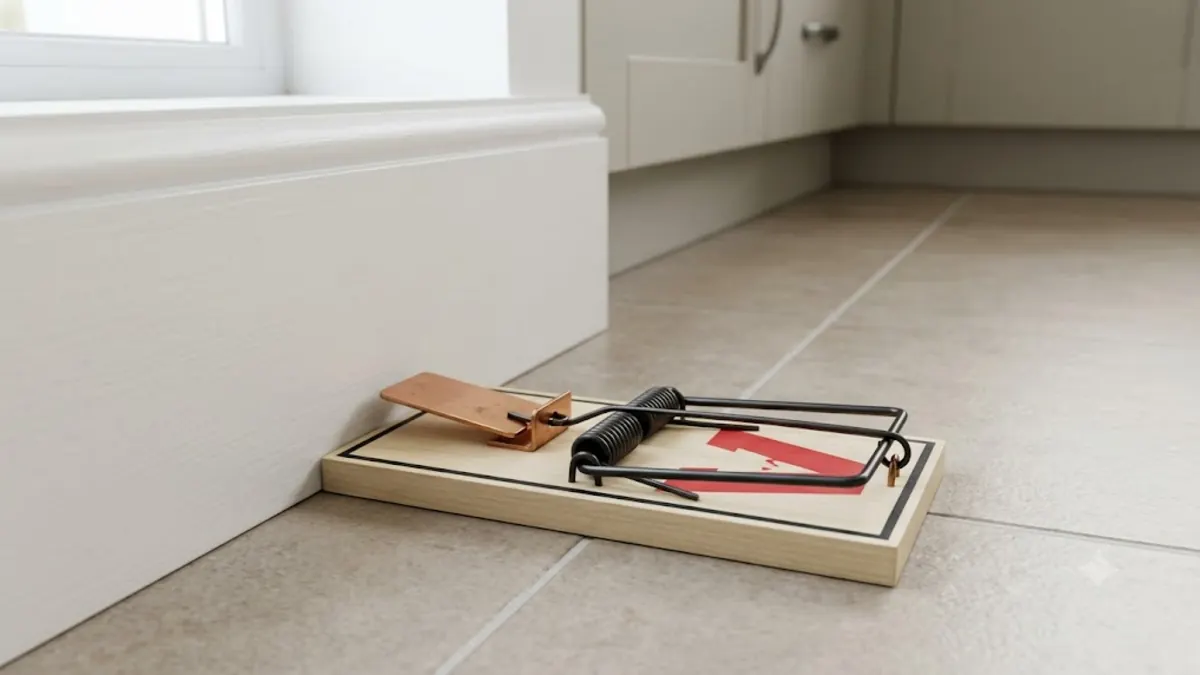
In a kitchen, the useful routes are usually edges and transitions. Check where a cabinet meets the floor, where plumbing passes through a wall, the narrow space beside an appliance, and the back of a pantry where stored food creates cover. A trap left in the center of an open floor may be easy for you to see but easy for a mouse following an edge to bypass. The CDC advises placing traps in areas with rodent signs and positioning the baited end beside the wall so the trap forms a T with it.
Safe access comes before convenience. A poison-free trap still has an exposed mechanical strike zone. Keep traps and bait where children and pets cannot reach them. “Behind the refrigerator” is not automatically protected if a cat can reach behind it, a child can pull the trap out, or the trap can be pushed into an inaccessible void. A good location is both isolated and retrievable.
Food-contact surfaces need a firm boundary. Do not place traps on a countertop, pantry shelf beside open food, cutting surface or dish-storage area. Use floor-level routes or enclosed cabinet zones that can be cleared, inspected and cleaned. Food should be moved into closed containers, and spilled ingredients, crumbs and accessible garbage should be dealt with at the same time. Trapping while leaving an easy food supply nearby makes the setup harder to interpret.
Renters have one extra constraint. You can usually remove accessible food, set traps in a protected location and document signs, but sealing pipe chases, damaged walls or shared-building entry routes may require the landlord or building manager. Photographing the opening and recording where signs recur is more useful than repeatedly moving traps without addressing the route.
Before setting anything, answer five questions:
Check
Why it matters
Is the trap sized for mice?
Rat traps and mouse traps use different scale and force; the page and products here are mouse-size.
Is there evidence of an active edge or runway?
Placement should follow signs and wall routes rather than an arbitrary open spot.
Can children and pets reach the trap or bait?
If yes, the location fails even though no poison is used.
Can the trap be retrieved and checked every day?
An inaccessible trap creates a sanitation and odor problem.
Are food and likely entry points being addressed too?
Trapping removes current animals; it does not close the route behind them.
Wall placement and bait contact work together
The familiar wall-placement advice is not a decorative rule. It changes how the mouse meets the mechanism. A mouse moving beside a wall can encounter the baited end without crossing a large open area. Placing the short, baited end against the wall creates the T-shaped orientation described by the CDC and Victor. The exact angle may need to change around a cabinet leg or appliance gap, but the aim stays the same: put the trigger where an active edge route meets it.
Use signs to choose the edge. A trap beside a clean, inactive stretch of baseboard may be perfectly oriented and still tell you little. Grease marks, droppings, gnawing, disturbed packaging and repeated sound from the same void are better placement clues. If signs occur behind two appliances and under a sink, treat those as separate routes rather than assuming one trap in the pantry represents the whole room.
Bait should encourage contact with the trigger, not provide a large meal beside it. Both Victor and the CDC describe using a small amount of bait. The useful amount depends on the pedal or cup, but the principle is consistent: put a small quantity on the intended bait surface so the animal has to interact with that part of the trap. A large blob that can be reached from the side can be removed without enough pressure on the trigger.
Peanut butter appears often in official guidance, but it is not a guaranteed universal bait. Food availability, route use and trap placement can matter as much as the bait itself. If bait disappears, do not immediately conclude that the trap is defective or that a different flavor will solve everything. Check whether the bait was loaded onto the trigger, whether the trap was fully latched, whether the product shifted, and whether the bait was accessible from an angle that avoided the pedal.
Pre-baiting also needs context. Advice to leave a trap baited but unset is often discussed for cautious rats. The CDC notes that mice may be more curious while rats can be wary of new objects. That does not make several days of pre-baiting a universal requirement for every house mouse. For this page, placement, correct sizing, a small amount of bait and daily inspection are the starting points. If activity persists and the trap remains untouched, reassess the route and species rather than applying rat guidance automatically.
The trap should remain stable on the surface. A rocking trap, uneven grout line or loose object underneath can alter how the animal approaches it and can make setting or retrieval awkward. Clear loose debris, keep the trap off wet surfaces and avoid locations where a cabinet door, appliance vibration or cleaning tool can strike it.
Match the trap architecture to the work you can actually do
All five products on this page are mouse-size snap traps, but they do not ask the same things of the person using them. The differences are most useful when translated into routine: how you load bait, how many routes you need to cover, how comfortable you are setting an exposed bar, whether you intend to discard or reuse the trap, and how you expect to release and clean it.
Traditional metal-pedal wooden traps expose the mechanism clearly. The Victor B0CQ8RSTC9 package contains 12 traps, which gives a household enough units to cover several observed routes or keep replacements available. The low-cost wooden format also makes discarding a used trap a realistic choice for people who do not want to clean it. The tradeoff is direct interaction with an exposed spring bar and a small metal pedal. Anyone uneasy about setting that mechanism should not force the process.
A wide-pedal wooden trap retains the wood base and exposed bar but changes the bait/trigger target. That can simplify bait placement for some users, yet a wider pedal is not proof of higher sensitivity or a better catch rate. It is a handling difference. The same safety and retrieval rules still apply.
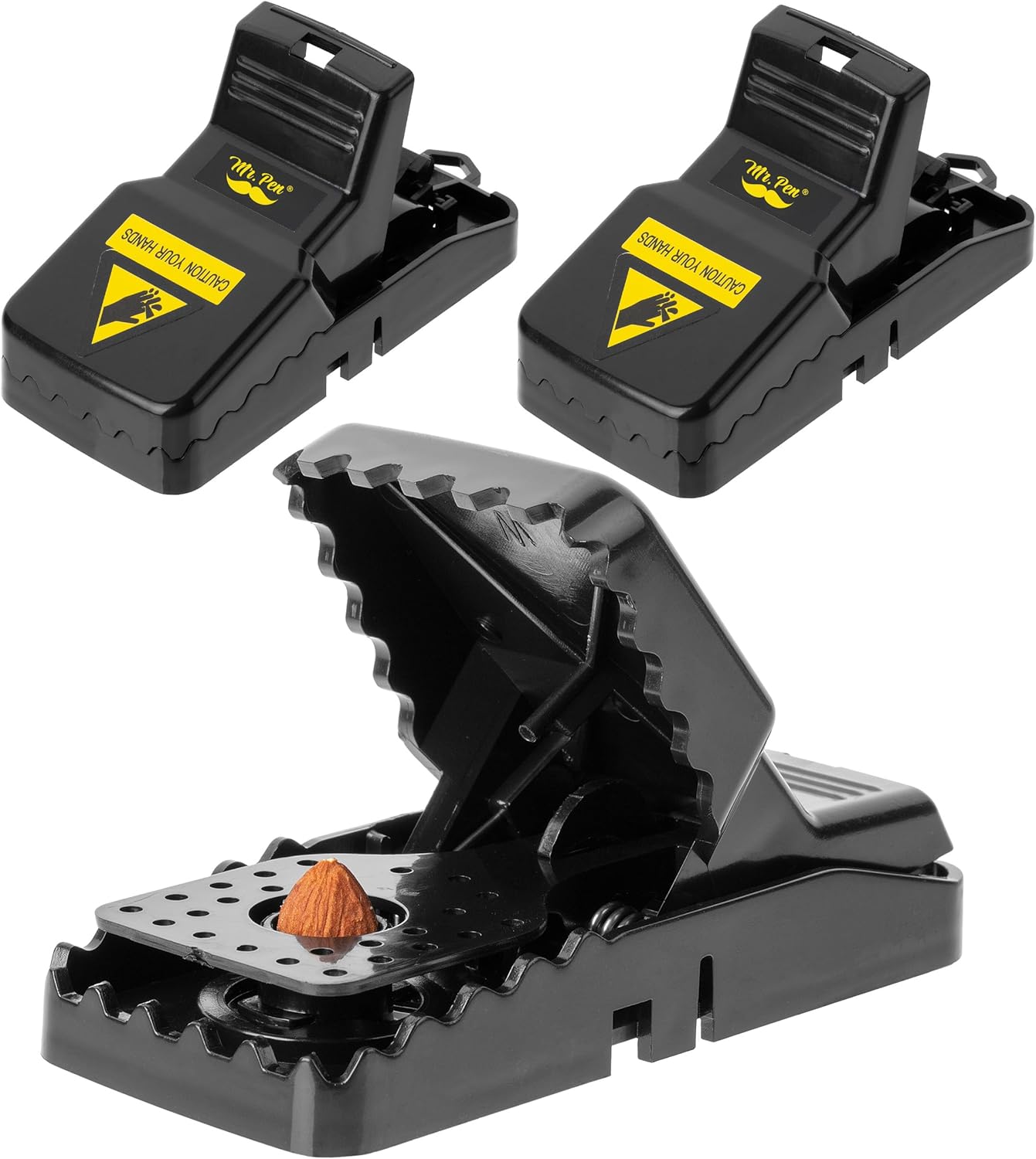
Molded plastic traps often use a removable bait cup, a larger top surface or a lever that can be pressed to set or release the mechanism. Those details may suit someone who wants to wash and reuse the body or reduce direct contact during release. They do not make an accessible trap safe for children or pets, and seller descriptions such as “humane,” “family friendly” or “zero escape” are not independent evidence.
Pack size is best read as a coverage option. A three-pack can make sense when signs are confined to one small cabinet and two nearby edges. A six- or twelve-pack is more flexible when several distinct routes need to be monitored at once. More traps do not guarantee faster control. They let you sample more plausible routes without moving one trap back and forth and losing track of what each location showed.
Product instructions and release details must be checked
Bulk plastic lever-release trap
Many placements with bait cups and less direct release handling
Still a mechanical hazard and not independently proven safer
Plan coverage across cabinets, appliances, and pipe routes
There is no reliable universal answer to “how many traps” without seeing the room. Count routes, not square feet. A small kitchen can contain several separate edges: the gap behind a refrigerator, the void under a sink, a pantry baseboard and a doorway into another room. One trap may cover one of those paths while leaving the others untouched.
Begin with the strongest, freshest signs. If droppings appear only behind one appliance, place traps on the likely approach edges and keep the rest of the room under observation. If signs occur in several cabinets or rooms, use multiple simultaneous placements rather than moving a single trap every night. The CDC recommends setting traps in areas where signs are present and continuing until activity stops.
Retrievability should shape the plan. A narrow gap may look ideal, but it is a poor location if the trap cannot be seen, pulled out or cleaned. Use a placement that keeps the baited end beside the wall while leaving the opposite end accessible. Do not slide a trap so far under an appliance that daily inspection requires moving heavy equipment.
An under-sink cabinet needs additional care. Clear cleaning products and loose objects that can interfere with the mechanism. Inspect pipe penetrations, but do not place the trap where a leak can wet it or where it sits beside utensils, food or absorbent household goods. If the gap around a pipe appears to be an entry point, trapping and repair should proceed as parts of the same plan.
Keep a simple location record when using several traps. A note such as “refrigerator left edge,” “sink pipe rear wall” and “pantry toe-kick” is enough. Record bait condition, whether the trap moved or fired, and whether new signs appeared. This is not a performance test. It prevents random repositioning and helps reveal whether one route remains active.
Fix bait theft and missed triggers without guessing
Three different observations are often collapsed into “the trap does not work”: the bait is gone while the trap remains set, the trap fires without a catch, or the trap is never touched. Each points to a different next check.
When bait disappears and the trap remains set, inspect access to the bait. Was there too much? Could it be reached from the side? Was it placed on the wood instead of the metal pedal or bait cup? Reduce the quantity and make the animal engage the intended trigger surface. Also confirm that insects or handling did not remove or disturb the bait.
When the trap has fired without a catch, do not infer a precise cause from one event. The trap may have shifted, been approached from an unexpected angle or been disturbed by something other than the target animal. Reset it only after checking that the location remains appropriate and inaccessible to non-target animals. Repeated unexplained firing is a reason to change the protected placement or trap architecture, not to advertise greater trigger force.
When a trap remains untouched while fresh signs continue nearby, revisit the route. The trap may sit on the wrong side of an appliance, too far from the wall or in an open area the mouse avoids. Food elsewhere may be easier to reach. The signs may also belong to a different route or species than assumed. Moving from evidence to evidence is more useful than changing bait repeatedly in the same inactive spot.
Setting difficulty is a valid product-fit problem. Follow the manufacturer's sequence and keep fingers clear of the strike zone. If the latch is hard to engage, the bar feels unsafe to control or the trap cannot be set consistently, stop and choose an architecture you can handle. A trap that is theoretically effective but remains unset in a drawer solves nothing.
What you observe
Check first
Avoid concluding
Bait gone, trap still set
bait quantity, placement on pedal/cup, side access, full latch
that one bait is useless or the trigger has a measured defect
Trap fired, no catch
stability, orientation, route, non-target access
that the product has a known miss rate
Trap untouched, signs continue
active edge, food competition, species/route assumption
that mice always avoid new traps
Trap difficult to set
instructions, hand position, product architecture
that forcing the mechanism is acceptable
Five snap-trap options for the same kitchen problem
Links in this comparison may earn this site a commission. Product details and current prices are shown on Amazon.
The products below are not ranked by catch rate because no independent side-by-side test was performed. They represent different ways to handle the same work.
Victor Metal Pedal Mouse Traps, 12 Pack — B0CQ8RSTC9
Where it fits: Several active routes need simultaneous coverage, and the user is comfortable setting, isolating and checking traditional exposed wooden traps. The 12-pack also supports a discard-or-reuse decision after each use.
Skip when: Children or pets can reach the placement, the exposed strike bar is difficult to set safely, or cleanup-sensitive users want a lever-release molded body.
Amazon and Victor support the exact 12-pack, wooden base, metal pedal and wall-placement instructions. They do not establish a catch rate, trigger force or comparative winner.
Where it fits: A six-trap plan needs a reusable non-wood option between a small plastic set and a twelve-pack.
Skip when: The buyer needs detailed current evidence about setting, release or enclosure behavior that the observed listing does not provide.
The listing supports the product identity, six-pack and polystyrene/steel construction. Mechanism-specific claims should remain limited until current manufacturer instructions are checked.
Where it fits: Several routes need coverage, while bait cups, washable molded bodies and lever-release handling matter more than a traditional wood format.
Skip when: The placements cannot be isolated from children, pets or other non-target animals.
The listing supports the pack size, ABS/metal construction, bait cup and lever form. Claims about sensitivity, humane performance or pet friendliness remain unverified seller claims.
The most useful comparison is between routines. Choose the traditional 12-pack when coverage and low-cost replacement matter and you can handle exposed traps. Choose the three-pack plastic option when the problem area is narrow and washability matters. Choose a lever-release bulk set when many placements and release handling matter together. None of these choices removes the need for protected placement, daily checks and sanitation.
Check every day and decide whether to clean, reuse, or discard
A trap location is not acceptable if it cannot be checked every day. Daily inspection limits the time a dead rodent remains in the kitchen, reduces odor and lets you see whether bait, placement or new signs have changed. Continue checking and resetting while fresh signs remain; a single catch is not proof that the route is closed.
For cleanup, follow the CDC's current rodent guidance rather than sweeping or vacuuming dry droppings and contaminated material. Wear appropriate gloves and wet contaminated material with disinfectant before handling it. The goal is to avoid stirring dry material into the air. Follow the disinfectant label for concentration and contact time.
For a dead rodent or used disposable trap, the CDC describes spraying the rodent and trap with disinfectant, allowing the required contact time, placing them in a plastic bag, sealing it and placing that bag inside a second sealed bag before disposal in a covered garbage container. Local disposal rules still apply.
Reuse is a workload decision, not an automatic advantage. Victor says its traditional trap may be discarded or reused. The CDC provides a method for disinfecting reusable snap traps, rinsing them and allowing them to dry. A wooden trap may be inexpensive enough that some households choose disposal; another household may prefer to clean and reset it. A molded plastic body may feel easier to wash, but this page has no comparative sanitation or odor-absorption test.
Keep the cleaning area away from food preparation. Do not rinse a trap over dishes or a food sink full of utensils. After glove removal, wash hands as directed by public-health guidance. If contamination is extensive, inaccessible or connected to a larger infestation, use the CDC's detailed cleanup guidance and consider professional help rather than treating this article as a complete remediation manual.
Stop new mice from replacing the ones you remove
Snap traps remove animals already using the space. They do not close a hole, store food or repair a damaged cabinet. A complete plan pairs trapping with exclusion and food control.
The CDC notes that mice can enter through an opening about one-quarter inch wide. Inspect around pipes under the sink, gaps behind appliances, cabinet penetrations, door edges and damaged wall or floor transitions. A visible hole does not prove it is the only route, but it gives the trapping record somewhere concrete to connect with repair work.
Seal food in durable containers and clean spills, crumbs and accessible pet food. Garbage needs a closing lid and regular removal. These steps do not replace traps when mice are already inside, but they reduce competing food and make ongoing activity easier to interpret.
In a rental, send the location record and photographs to the responsible property contact when a repair affects the building. Avoid making a permanent alteration you are not authorized to make. In a multi-unit property, repeated signs can reflect a shared route that one tenant cannot solve by adding traps inside a single kitchen.
Use a stopping rule based on activity, not a fixed number of nights. Keep inspecting and trapping until new signs stop. If fresh droppings, gnawing or noises continue despite well-placed traps and food control, reassess the route, species and building access. The absence of a catch is not the same as the absence of mice, and a catch is not the same as a sealed entry point.
When a household snap-trap plan is no longer enough
Professional or building-level help makes sense when activity persists in inaccessible walls, ceilings or shared areas; when the suspected animal may not be a house mouse; when traps cannot be placed without access by children or pets; or when cleanup involves extensive contamination. The same applies when structural repairs, plumbing penetrations or common-building routes are outside the occupant's control.
Do not invent a numerical threshold such as “three mice means an infestation.” The evidence available here does not support one. Use persistence, spread, inaccessible areas, repeated fresh signs and inability to operate the traps safely as escalation signals.
Glue boards, live-catch traps and poison products are outside this page's product set. The CDC recommends traditional snap traps for household rodent reduction and advises against glue and live traps in its current guidance. That boundary keeps the comparison focused; it is not a claim that every household situation can be solved with the five products shown here.
A practical setup using the Victor 12-pack
The Victor B0CQ8RSTC9 pack is most useful when its quantity supports a mapped placement plan. Imagine fresh signs behind a refrigerator, under the sink and along a pantry toe-kick. Those are three route groups, not one generic “kitchen” location. A user could place more than one trap around the strongest approach edges while retaining units for another route or replacement. The exact allocation depends on access and signs; twelve is an available quantity, not a prescribed number.
Use the Victor instructions and keep the baited metal-pedal end beside the wall. Apply only a small amount of bait to the pedal. Set the trap with hands clear of the strike zone, then place it only where it remains protected and retrievable. If setting the metal pedal and exposed bar feels unsafe or inconsistent, switch architecture rather than forcing it.
Check every placement daily and keep a location note. If one route shows repeated activity while the others remain untouched, investigate that route's food source and possible opening. If bait disappears, adjust bait contact and orientation before assuming a trigger defect. If a trap is used, choose the CDC-aligned discard or cleaning route before resetting.
This setup does not prove that the Victor model catches more mice than the alternatives. Its evidence-backed advantage for this scenario is simpler: twelve exact mouse-size wooden traps make simultaneous placements possible, and the manufacturer provides a clear bait, set and wall-placement sequence. The exposed mechanism and cleanup burden remain real fit limits.
What the evidence can and cannot tell you
This guide combines the exact Amazon product configurations, Victor's instructions and current CDC guidance for trapping, cleanup and sealing. It also uses recurring shopper questions to decide what needs explanation. Customer reviews and forum discussions were not quoted or treated as factual proof.
No trap on this page was set, triggered, used to catch a mouse, cleaned or durability-tested for this article. There is no measured catch rate, trigger force, kill time, miss rate, wash cycle, odor test or child/pet enclosure test. For that reason, the page does not name a “best,” “safest,” “most humane” or “most sensitive” product.
Product titles, pack quantities, images and links were checked on July 11, 2026 and should be refreshed before publication. Prices, coupons, ratings, review counts, availability and delivery promises are deliberately omitted because they change and require an approved current-data source.
There is no supported universal winner here. Choose a mouse-size snap trap that you can set correctly, isolate from children and pets, retrieve daily and clean or discard. Product architecture and pack size should match that routine.
Where should a snap trap sit relative to a wall?
Place it on an active route with the baited end beside the wall so the trap forms a T with the wall where practical. Keep it stable, protected and retrievable.
Why is the bait gone but the trap did not trigger?
Too much bait or bait placed away from the pedal or cup can allow feeding without enough trigger contact. Use a small amount on the intended bait surface, confirm the trap is fully set and reassess the route before changing products.
Can a traditional snap trap be cleaned and reused?
Yes, when the product permits reuse and the current CDC cleaning method is followed. Discarding a used low-cost wooden trap is also a valid choice. Follow disinfectant labels and local disposal rules.
How do you stop mice from getting back into a pantry?
Trapping needs to be paired with closed food storage, controlled garbage and inspection of gaps around pipes, cabinets, appliances and doors. The CDC notes that mice can use openings about one-quarter inch wide.
A suitable snap-trap plan has four parts: a mouse-size trap on an active edge, a location that stays inaccessible to children and pets, daily retrieval, and a parallel effort to remove food access and seal entry points.
How to decide when an indoor insect barrier spray fits ants, roaches, and spiders around doors and windows, with label safety, IPM limits, and five Amazon product options.