Start With the Seal, Not the Strap
The part that touches the face is usually called the gasket or skirt. Its job is to follow the contours around the eyes closely enough to keep water out. The bridge controls the spacing between the two lens areas, while the strap keeps the goggles from shifting once the gasket is seated. These parts work together, but they do not do the same job.
That distinction matters because many fitting problems are treated as strap problems. A caregiver sees water entering and tightens the strap. If the gasket is already sitting evenly, a small adjustment may help. If one edge bridges across a cheek, temple, or narrow nose area, extra tension can pull the frame harder against the wrong contact points without closing the original gap. The child then gets both discomfort and leakage.
Hold the goggles against the face before using the strap. Speedo's current goggle-care guidance recommends looking for slight suction and comfortable, even pressure around the eyes. This will not prove that a pair can stay sealed for an entire lesson, but it quickly rules out frames that never make balanced contact.
Frame shape changes where that contact occurs. A small socket-style goggle sits close to the eye sockets and usually has a compact profile. A mask-style or outer-eye goggle uses a larger gasket that reaches farther toward the brow, cheek, and temple. The larger footprint can feel less concentrated for some children and can offer a broader view, but it also has to match more of the face. A narrow face may leave gaps under a broad gasket even when the listed age range appears correct.
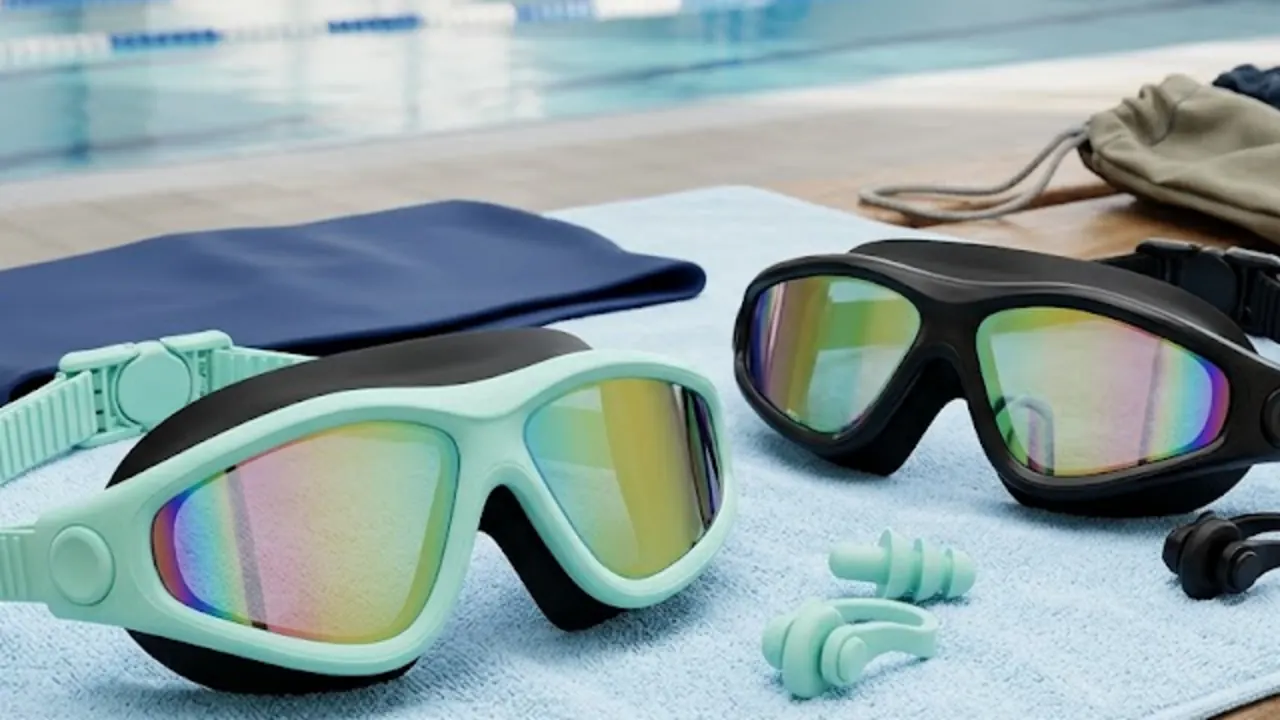
The Seago two-pack anchored in this guide is an example of the larger approach. Its listing image shows a broad mirrored lens area, a thick black outer skirt, a fixed bridge, round side controls, and rear buckle hardware. Those visible features make it useful for discussing wide-seal fit. They do not prove that the pair will feel comfortable on every child from age 3 to 14, and the listing's age range should be treated as a starting filter rather than a measurement.
A Five-Minute Fit Check Before the First Lesson
Do the first fitting at home, where the child is dry and neither of you is rushing to join a class. The goal is not to create the tightest possible seal. It is to find the lightest stable fit that remains even when the child moves.
| Step |
What to do |
What you are checking |
What a problem suggests |
| 1. Inspect the parts |
Look at the gasket, inner lens, bridge, buckle, and strap |
Twists, residue, cracks, stretched areas, or trapped hair |
Cleaning, damage, or poor assembly can mimic a fit problem |
| 2. Center the bridge |
Place the bridge over the nose and settle both sides at the same height |
Whether both gaskets reach the face evenly |
One side may sit too high, low, wide, or narrow |
| 3. Press without the strap |
Apply light pressure, then release slightly |
Brief suction and even contact on both sides |
Immediate release on one side points to a contour mismatch or poor placement |
| 4. Add the strap gradually |
Position it high enough to resist slipping and tighten in small steps |
Stability without concentrated pressure |
A very tight strap is compensating for something else |
| 5. Add movement |
Ask the child to blink, look around, smile, and turn the head gently |
Whether facial movement opens a gap or causes pinching |
The frame may be too broad, bridge may be wrong, or strap may be misplaced |
| 6. Repeat poolside |
Recheck after adding a cap, wetting hair, or applying sunscreen |
Whether the real lesson setup changes the seal |
Hair, cap edges, and slippery skin can require reseating, not simply more tension |
Begin by checking the gasket and lens while they are dry. A folded edge, a strand of hair, dried pool residue, or a twisted strap can create a local gap. If the lens looks cloudy while dry, the issue may be scratching or coating wear rather than condensation. Correct these visible issues before judging the frame size.
Next, center the bridge and press the goggles lightly into place. Both sides should contact at roughly the same time. If the left side holds and the right side lifts immediately, do not assume the right strap needs to be shorter. Reseat the bridge, check for hair, and try a slightly different vertical position. If the same edge continues to release, the gasket footprint may not match that side of the face.
Only then add the strap. It should prevent the frame from sliding when the child turns or pushes off the wall, but it should not be doing all the sealing work. Make small changes and ask the child where the pressure is felt. Pressure concentrated at the nose bridge, outer corner, or one eye is more informative than a general request to make the goggles tighter.
A narrow face is a common challenge for large outer-eye designs. The gasket may contact at the brow and outer cheek while floating over a smaller contour near the nose or lower eye area. In that case, a more compact frame or a different bridge geometry may work better. For a younger child, the issue may instead be handling: a rear buckle can be easy for a caregiver but difficult for small hands. That affects lesson independence even when the seal itself is good.
Repeat the check at the pool. A cap can sit under a strap, wet hair can become slippery, and sunscreen near the gasket can reduce grip. The correct response is usually to reseat the contact surface and clear the edge. A large last-minute increase in tension often makes it harder to tell whether the original frame was compatible.
What the Frame Shape Changes
The words on a listing rarely describe the full fit. Kids, wide view, and no leak may apply to several very different designs. Compare the parts that physically touch the child and the way the child will handle the goggles during class.
| Format |
Contact area |
Likely strengths |
Common tradeoffs |
Best lesson context |
| Wide mask-style gasket |
Around the outer eye area |
Broad view, less direct contact with the eye socket for some faces |
More face area must match; can be bulky with caps or narrow faces |
Beginners who prefer a larger frame and easy visual orientation |
| Conventional child socket goggle |
Closer to the eye sockets |
Compact, familiar, easier to use under some caps |
Pressure is more concentrated; bridge fit can be sensitive |
General lessons and older children comfortable with standard goggles |
| Younger-child unibody frame |
Soft integrated frame with simple bridge |
Fewer adjustment points and easier setup |
Limited bridge customization and narrower age window |
Preschool and early beginner lessons |
| Compact junior practice goggle |
Lower profile with smaller gasket |
Less bulk and a more practice-oriented feel |
May feel tighter and offer a narrower contact area |
Older children moving toward regular practice |
| Fabric or bungee strap design |
Varies by lens/frame |
Can reduce hair pulling and simplify handling |
Strap comfort does not fix an incompatible gasket |
Long or curly hair when pulling is the main complaint |
Mask-style goggles are not automatically more comfortable. They move the contact line away from the immediate eye socket, which can help a child who dislikes small cups pressing close to the eyes. At the same time, the larger skirt has to follow a wider section of brow and cheek. A child with a petite or narrow face may get a more reliable seal from a smaller frame even if the larger pair feels soft when first pressed on.
Conventional child goggles place more of the decision on bridge spacing and individual cup alignment. Some have interchangeable bridges; others use a fixed flexible bridge. A good compact fit can stay stable with modest strap tension. A poor one can pinch at the nose or require each cup to be adjusted repeatedly. The relevant comparison is not large is comfortable versus small is tight. It is whether the chosen contact line matches the child's face and remains stable during lesson movements.
Age labels help narrow the shelf, but they cannot describe cheek shape, nose width, brow depth, or head size. This is why products with overlapping ranges can serve different children. The Seago and Aegend options in this guide are both listed across broad child age ranges and both come as two-packs, yet their frame geometry differs. Aqua Sphere's SEAL Kids is another broad-frame path. ZIONOR's G1MINI SE creates a more compact older-child option, while Speedo Sunny G is positioned around a younger age band.
Lesson type also matters. A beginner who stops frequently, lifts the goggles to listen, and needs a caregiver to help with the buckle may value a forgiving frame and simple release. A child beginning team practice may care more about a lower profile that stays put through faster push-offs. Neither task is the same as snorkeling, and a mask with a nose pocket should not be substituted for ordinary lesson goggles unless the class specifically calls for that equipment.
When Leaks, Pressure and Fog Point to Different Problems
Leaks, discomfort, and poor visibility can happen together, but they do not always share one cause. Use the first symptom to decide what to inspect before changing the strap.
| What happens |
Likely signal |
Check first |
Low-risk next step |
When to try another format |
| Water enters immediately on one side |
Uneven gasket contact, hair, or bridge position |
Dry contact around that edge |
Clean and reseat; move the frame slightly |
The same edge never holds light suction |
| Water enters only during movement |
Strap placement, frame shift, or facial movement opens a gap |
Strap height and movement test |
Raise/reseat strap; tighten one small step |
Stability requires uncomfortable tension |
| Pressure at nose or eye socket |
Bridge or contact zone mismatch |
Exact pressure location |
Loosen, recenter, and compare another bridge/frame |
Pressure returns before a stable seal forms |
| Strap slips or pulls hair |
Strap route, cap position, or strap material |
Hair caught under the strap |
Clear hair, adjust cap, or consider fabric/bungee format |
Hair pulling is the main reason the child removes goggles |
| Lenses fog after several minutes |
Condensation or aging/handled coating |
Inner-lens condition and care routine |
Rinse, avoid rubbing, air dry, follow exact instructions |
Persistent haze remains even when dry |
| Lens looks dull or scratched when dry |
Physical wear rather than temporary fog |
Surface under good light |
Store separately and avoid further rubbing |
Scratches interfere with vision |
| Child keeps removing the goggles |
Discomfort, fear, poor visibility, or handling difficulty |
Ask where and when it bothers them |
Separate fit, fog, and buckle problems |
Another frame is easier than repeated forced adjustment |
An immediate one-sided leak is usually the clearest fit signal. If cleaning and reseating do not change which edge releases, the contact shape is suspect. Tightening both sides equally may increase overall pressure while leaving that local gap. A different bridge width or smaller gasket can be a more rational next step.
A leak that appears only when the child looks sideways, smiles, or pushes off is different. The dry seal may be adequate, but the frame may shift because the strap sits too low or the buckle is loose. Adjust stability in small increments and repeat the movement. If the goggles stay dry only when the child reports significant pressure, the frame is not earning its place simply because it can be forced to seal.
Pressure gives useful location information. Nose pressure points toward bridge spacing or frame position. Outer-corner pressure may indicate that a wide frame is being drawn around a narrow face. Pressure close to the eye socket is more typical of a compact cup. The page cannot diagnose pain, skin reactions, or eye conditions. Stop using equipment that causes pain or irritation and seek appropriate professional advice when symptoms persist.
Fogging is often blamed on fit, but warm moist air can condense on the lens even when the gasket is seated. Anti-fog treatments slow that process; they do not remove moisture from the environment or last forever. Touching the inner lens, rubbing it with a towel, leaving it wet in a bag, and normal coating age can all reduce clarity. If the lens is clear while dry and fogs during use, care and ventilation are more relevant than strap tension.
A dry lens that remains cloudy or scratched has moved beyond ordinary fogging. Storage matters because mirrored and coated surfaces can be damaged by loose items in a swim bag. A protective pouch and full air drying are simple ownership details, but they often determine whether a pair remains usable through a lesson season.
A child who repeatedly removes goggles is telling you something specific. The problem may be pressure, blurred vision, hair pulling, water entering, or a buckle they cannot operate. Ask where the goggles bother them and when it happens rather than assuming they simply resist the lesson. Choose the frame that addresses that problem without constant readjustment.
Make the Goggles Work Through a Full Lesson
Fitting at home is only the first pass. The lesson environment changes how the equipment behaves and which features matter most.
Indoor lessons with frequent stops. Beginners often lift their goggles to hear instructions, then put them back on without fully reseating the gasket. A quick-release rear buckle can make removal easier, but the child or caregiver still needs to center the frame each time. Teach one short routine: clear hair, center the bridge, press both sides, then settle the strap. Repeating that sequence is more reliable than tightening the strap once and leaving it overly snug for the full class.
Outdoor pools. Mirrored lenses can reduce visible brightness and glare for some swimmers, while clear or lighter lenses often make more sense indoors. The Seago listing describes UV treatment, but this guide did not verify an independent protection rating for the exact ASIN. Treat outdoor lens claims as a listing feature to confirm, not a substitute for broader sun protection or a certification statement.
Caps, long hair, and curly hair. Hair under the gasket creates a direct leak path. Hair under a thin silicone strap can also pull when the goggles are removed. A cap can help control hair, but its edge must not sit under the gasket. When hair pulling is the main complaint and the facial seal is otherwise easy to achieve, a fabric or bungee-style strap may be a better category direction than changing only the lens shape.
Siblings and backup pairs. A two-pack is useful when both pairs have been fitted to the intended child. It can cover a forgotten pair, a scratched lens, or two children with similar needs. It is not automatically better value if the frame matches neither face. Fit one pair before treating the second as a benefit. If siblings have different face widths, a mixed-format shortlist may be more useful than two identical goggles.
Younger versus older children. A younger child may need a simple unibody frame and caregiver-operated buckle. An older child may prefer a more compact frame they can adjust independently. The broad 3-14 age range on some listings spans major changes in face size, coordination, and lesson intensity. The dry fit and handling check should carry more weight than the number printed in the title.
Five Goggles Worth Comparing by Fit Style
Some product links may earn this site a commission. Product details and current prices are shown on Amazon.

Seago Swim Goggles 2 Pack for Kids 3-14
Wide mask-style two-pack
Where it fits: The exact image shows a broad outer-eye mask-style gasket, fixed bridge, mirrored lens area, rear quick-release hardware and two-pair format. It belongs on the shortlist when a child prefers a larger frame and both gaskets make even contact with light suction.
Try another frame when: Recheck or skip when a narrow face leaves a gap at the inner or lower gasket, the large frame conflicts with a cap, or stable sealing requires uncomfortable strap tension.
What this listing can and cannot tell us
The exact ASIN identity, variant and visible construction were observed. No independent child wear, leak, pressure, anti-fog duration, scratch or UV test was performed. Amazon currently emits a different family canonical and must be rechecked.

Aegend Kids Swim Goggles, Pack of 2, Ages 3-14
Conventional child-frame two-pack alternative
Where it fits: It preserves the two-pack and broad child age positioning while using a more conventional two-lens frame, giving families a smaller contact-footprint alternative to the Seago mask-style design.
Try another frame when: Recheck when the child dislikes pressure close to the eye socket or the bridge cannot center both cups without extra strap tension.
What this listing can and cannot tell us
Amazon search and exact-ASIN discovery support the product identity and child two-pack role. Seller comfort and no-leak claims are not independent performance evidence.

Aquasphere SEAL Kids Swim Goggles, Ages 3+
Wide mask-style single-pair alternative
Where it fits: It offers another established wide-vision, outer-eye mask-style path when a child likes the larger contact zone but does not match the Seago geometry.
Try another frame when: Recheck when the child needs a compact practice frame, the wider skirt bridges over a narrow face, or a single-pair format does not meet the household's backup needs.
What this listing can and cannot tell us
Amazon and Aquasphere discovery support the SEAL Kids identity, ages 3+ positioning and wide-mask role. The page has not performed a head-to-head seal or comfort test.

ZIONOR G1MINI SE Kids Swim Goggles, Ages 6-14
Compact older-child practice alternative
Where it fits: Its more compact child-goggle format gives older children a lower-bulk alternative when a broad mask-style gasket feels oversized or conflicts with a cap.
Try another frame when: Recheck for younger children, swimmers who dislike socket-area contact, or anyone who needs the broader field of view of a mask-style frame.
What this listing can and cannot tell us
Exact-ASIN discovery supports the G1MINI SE identity and ages 6-14 positioning. No independent comfort, leakage or UV verification was performed.

Speedo Sunny G Kids' Swim Goggles, Ages 3-8
Younger-child age-boundary alternative
Where it fits: The narrower ages 3-8 positioning creates a useful younger-child comparison when broad 3-14 frames appear oversized or unnecessarily complex.
Try another frame when: Recheck when the child has outgrown the frame, needs a more practice-oriented profile, or the younger-child geometry does not match a wider face.
What this listing can and cannot tell us
Speedo and Amazon discovery support the Sunny G identity and listed age range. No independent fit or no-leak test was performed.
Use the comparison to narrow the shortlist, then fit the actual pair. Seago and Aquasphere are the clearest wide-frame paths. Aegend keeps the two-pack format with a more conventional shape. ZIONOR is a compact option for older children, while Speedo Sunny G focuses on younger swimmers. Age labels and listing phrases are not enough on their own; the gasket, bridge, handling, and lesson context still decide the result.
Keep the Lenses Clear Longer
Goggles fog when warm, moist air condenses on a cooler lens surface. An anti-fog coating changes how that moisture forms and spreads, helping the lens stay usable for longer. It does not make condensation impossible, and the treatment can become less effective with handling, cleaning, scratches, and age.
Avoid rubbing the inner lens with fingers, towels, or the corner of a shirt. The inside is the surface most likely to carry the anti-fog treatment. If a child touches it during class, rinse rather than polish it dry. The outside can also scratch, especially when mirrored lenses are stored loose beside buckles, clips, or hard pool gear.
After a lesson, rinse the goggles gently and let them air dry fully before closing them in a bag or case. Speedo's general care guide advises lukewarm water, minimal contact with the lenses, flat air drying, and protective storage. It also warns that soap or detergent can damage some anti-fog coatings.
The exact Seago product page currently gives different general care wording and mentions mild soap and water. Because coating instructions can vary, follow the instructions supplied with the exact pair you buy. This page does not recommend a universal cleaner. When the listing, package, and category advice disagree, the safest editorial conclusion is to avoid rubbing and harsh chemicals and confirm the manufacturer's current instructions.
Store the dry goggles in a protective pouch rather than under wet towels or loose accessories. Do not leave them exposed to high heat or prolonged sunlight in a parked car. A simple care loop works well: rinse, inspect, air dry, and store separately.
Replace or retire a pair when the gasket cracks or remains deformed, the strap no longer holds adjustment, the buckle fails, or scratches interfere with vision. Persistent haze that is visible while the lens is dry is not ordinary in-pool fog. It is a sign to inspect for residue, coating damage, or physical wear rather than continuing to tighten the goggles.
When a Wide Mask-Style Pair Is the Wrong Starting Point
A wide frame is easy to recognize and can feel reassuring to a beginner, but it is not the default answer for every child. The main reason to change direction is repeated uneven contact. If a large gasket holds at the brow and temple but releases near the nose or lower cheek, a smaller footprint or different bridge may fit with less pressure.
Children moving into team practice may also want a lower-profile frame. Faster push-offs, dives, caps, and repeated lap work place a different value on stability and drag than a first set of weekly lessons. A product designed around beginner comfort and broad visibility can still work, but it should not be selected only because it looks larger or softer.
Some children simply dislike the physical presence of a mask-style frame. Others care more about hair pulling than gasket pressure. In that case, a fabric or bungee strap can address the actual complaint, provided the lens and gasket still fit. Prescription needs are another separate path; a standard mirrored child goggle does not solve vision correction.
| Choose or keep a wide mask-style pair when |
Try another format when |
| The outer gasket makes even contact with light suction |
One edge repeatedly releases on a narrow contour |
| The child prefers a broad view and contact away from the socket |
The child wants a compact frame under a team cap |
| The buckle and strap can be repeated easily at lessons |
Stable sealing requires uncomfortable tension |
| The frame stays clear of hair and cap edges |
Hair pulling or strap handling is the main problem |
| The child is a beginner using the goggles for ordinary lessons |
The swimmer needs prescription or racing-specific equipment |
If the strap is compensating for incompatible geometry, change the frame style instead of tightening it again.
Goggles Help With Visibility, Not Water Competency
Goggles can make underwater vision more comfortable and can help a child participate in a lesson. They do not teach swimming skills, prevent drowning, or replace close and constant supervision. The American Red Cross recommends swim instruction and emphasizes supervision and appropriate U.S. Coast Guard-approved life jackets for young or inexperienced swimmers where needed.
Keep those safety decisions separate from the product comparison. A comfortable pair of goggles supports the lesson routine; it is not protective flotation or a substitute for an attentive adult.
How We Checked the Products and Advice
The Seago ASIN, title, selected color, and exact product image were checked on July 11, 2026. Amazon's live page currently shows a variant-family canonical URL that differs from the hidden B08JPC2M46 ASIN, so the product identity and link should be checked again before purchase or publication.
The fitting and care method draws on the visible product geometry and Speedo's current goggle-care guidance. The water-safety boundary follows the American Red Cross swim-safety guidance. Product questions and caveats were informed by recurring search and user-discussion themes, but no customer review text, rating, or review count is reproduced here.
We did not conduct a child wear test, leak test, pressure measurement, scratch test, anti-fog duration test, or UV certification review. Product titles, images, variants, and availability can change. Corrections and source updates should be sent through the site's contact route.
Frequently Asked Questions
How do I know whether kids' goggles fit before a lesson?
Center the bridge and press the goggles lightly against clean, dry skin without the strap. Both sides should make even contact and hold briefly without sharp pressure. Then add the strap only to stabilize the seal and repeat the check while the child blinks, smiles, and turns their head.
Can overtightening make goggles more uncomfortable and still leave gaps?
Yes. Extra tension can increase pressure without correcting a gasket or bridge that does not match the face. If the same edge leaks after cleaning and reseating, loosen the strap, repeat the dry contact check, and compare another frame shape instead of continuing to tighten.
Are mask-style goggles better for beginners?
They can be a good starting point for children who prefer a broad view and contact outside the eye socket. They are not universally better. A large skirt must match more of the face, so a narrow or petite face may seal more easily with a smaller child frame.
What should I try for a child with a narrow face?
Look for a smaller gasket footprint, a bridge that centers both sides, and a frame that holds light suction without high strap tension. Do not rely on a broad age range. If a large outer gasket repeatedly releases near the nose or lower cheek, compare a compact child goggle.
Why do anti-fog goggles start fogging?
Warm moisture still reaches the lens, and anti-fog treatments can become less effective through touching, rubbing, residue, scratches, and normal age. Rinse gently, avoid rubbing the inner lens, air dry fully, and store the goggles separately. Follow the cleaning instructions for the exact pair.
Can I use soap on the inner lenses?
Do not assume one rule fits every coating. Speedo's general care guidance warns against soap and detergent, while the current Seago page mentions mild soap in its care text. Follow the instructions supplied with the exact goggles and avoid rubbing or harsh chemicals.
Are mirrored lenses necessary for indoor lessons?
Usually not. Mirrored or darker lenses may help with bright outdoor conditions, while clear or lighter lenses can make an indoor pool easier to see. Lens tint does not fix a poor gasket seal, and seller UV claims should be checked for the exact variant.
When should children's goggles be replaced?
Replace them when the gasket is cracked or permanently distorted, the strap will not hold adjustment, the buckle fails, or scratches and dry haze interfere with vision. A pair that requires uncomfortable tension to seal may need a different frame rather than another repair.
The Practical Decision
For comfortable kids' swim goggles in lessons, begin with the face-to-gasket match rather than the product promise. A good candidate holds light, even contact before the strap is tight, stays stable through simple movement, and can be reseated without disrupting the class. The Seago two-pack is a reasonable wide-frame candidate when that geometry fits. The other four products cover cases where age, face width, pressure location, or lesson style points elsewhere.
Browse all practical guides